

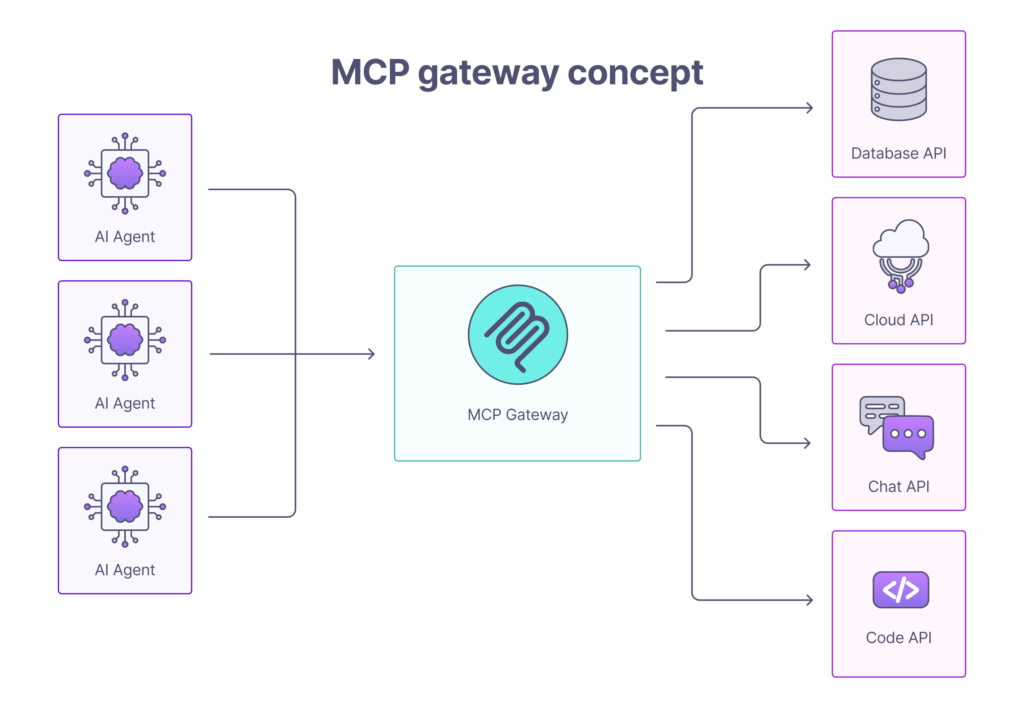
A Model Context Protocol (MCP) gateway is a reverse proxy that sits between AI agents and MCP servers, applying the same governance, authentication, rate limiting, and observability controls that API gateways provide for REST APIs. It is the control plane for agentic AI infrastructure.
- MCP gateways extend proven API gateway patterns (auth, rate limiting, observability, access control) to AI agent tool calls over the Model Context Protocol.
- Without a gateway layer, enterprises face unaudited tool access, credential sprawl, context window bloat, and zero visibility into agent-to-server traffic.
- Many market-leading API gateway providers have already shipped production MCP gateway solutions. Gartner projects that 75% of API gateway vendors will have MCP features by 2026.
- If you already run an API gateway, MCP gateway adoption is a natural extension of your existing governance model, enabling agentic AI at scale. It’s not a replacement, as API gateways and MCP gateways serve different purposes.
What is an MCP gateway?
An MCP gateway is an intermediary service that intercepts, authenticates, and governs all traffic between AI agents and the MCP servers those agents call. Think of it as the same architectural role an API gateway plays for microservices, applied to AI tool invocations.
Anthropic’s Model Context Protocol standardizes how AI agents discover and invoke external tools, including databases, file systems, SaaS APIs, and internal services. MCP defines the communication shape and sequence, effectively serving as another HTTP-based protocol with OAuth and structured request/response contracts. The protocol solves interoperability. The MCP gateway solves governance.
Without a gateway, each agent-to-server connection is a direct, ungoverned call. Credentials get embedded in agent configs. There is no central audit log. Rate limits don’t exist. This is the same “wild west” pattern the REST API ecosystem went through before API gateways became standard infrastructure. It’s why MCP standardization matters for the AI supply chain.
An MCP gateway provides a single point of management where the gateway owns the credentials, enforces policies, and emits telemetry. Deploying this pattern in production environments reduces credential sprawl by consolidating secrets into one managed layer.
How does an MCP gateway differ from an API gateway?
Both MCP gateways and API gateways are reverse proxies that enforce policy at the network edge. The differences are in protocol, traffic shape, and the additional concerns that AI agents introduce.
| Dimension | API gateway | MCP gateway |
| Protocol | REST, gRPC, GraphQL, WebSocket | MCP (HTTP+SSE, streamable HTTP) |
| Consumer | Applications, frontend clients | AI agents, LLM orchestrators |
| Auth model | API keys, OAuth 2.0, JWT | OAuth 2.1 (per MCP spec), SSO, agent identity tokens |
| Traffic pattern | Request-response, streaming | Tool discovery plus invocation, session-based |
| Unique concern | Payload validation, versioning | Context window management, tool filtering, prompt injection defense |
| Observability | Latency, error rate, throughput | Token usage, cost tracking, tool call frequency, agent behavior |
The critical new concern is tool governance. An API gateway doesn’t need to decide which endpoints a consumer can discover. An MCP gateway does. It must control which tools an agent sees and can invoke based on policy, role, and context. One production approach, for example, uses BM25 semantic matching to expose only three to five relevant tools per query, solving the context window bloat that otherwise degrades agent performance.
Why do enterprises need MCP gateways?
Enterprises need MCP gateways because MCP servers operate outside traditional security perimeters. Every MCP server grants agents permissions to execute commands, modify databases, delete files, and trigger workflows. Without centralized governance, the blast radius of a compromised server is unbounded.
Noma Security identified five critical MCP security blindspots in production deployments: typosquatting, excessive permissions, malicious code execution, insecure communications, and inadequate observability. Traditional security tools were not designed for the dynamic, interconnected nature of AI agent ecosystems, a gap that API governance in the age of AI must address for both human and machine consumers.
| Problem | Without MCP gateway | With MCP gateway |
| Credential sprawl | Each agent embeds secrets for every MCP server | Gateway owns all credentials centrally |
| No audit trail | Tool calls are invisible to security teams | Every invocation is logged with agent identity, timestamp, and payload |
| Uncontrolled access | Any agent can call any tool | Policy engine (e.g. OPA) enforces per-agent, per-tool permissions |
| Context bloat | Agents receive hundreds of tool definitions | Gateway filters to relevant tools per request |
| Cost overrun | No visibility into token or API consumption | Real-time cost tracking and rate limiting per agent |
| Compliance gaps | No SOC 2 or regulatory audit support | Centralized logging meets compliance requirements |
| Brand risk | Agents operate without tone or domain guardrails | Centralized policy enforces brand guardianship and domain context |
The enterprise architects we work with consistently raise the same point: They already solved these problems for REST APIs with their API gateway, and now they need to do the same for MCP. As one enterprise architect noted, MCP is a natural fit for API auditing and domain borders, as the governance patterns transfer directly.
What stays the same: Leveraging core API management policies (auth, quotas, logging)
Moving to an MCP gateway is an evolution, not a do-over. The core pillars of API management remain essential as a solid foundation for and enterprise-grade AI-driven architecture. These include:
- Authentication and authorization: Identity still underpins everything. Whether the caller is a user, service, or AI agent, robust authentication and authorization policies are critical. Modern gateways must unify identity across humans, services, and agents, while also introducing more contextual access controls, ensuring that actions taken by AI systems are scoped appropriately to user intent and permissions.
- Rate limiting, quotas, and caching: AI workloads can be both bursty and expensive, making traditional controls even more important. Rate limiting and quotas help manage cost and prevent abuse. Caching becomes more strategic, with responses, embeddings, and intermediate outputs all able to be reused. Policies, meanwhile, must enable efficiency across increasingly complex interaction patterns. This ensures performance and cost control remain predictable even as workloads grow more dynamic.
- Logging and observability: The need to observe system behavior doesn’t go away with the introduction of agentic AI. In fact, it expands, as in addition to standard logs, MCP gateways must capture prompts and responses, token consumption, and multi-step reasoning traces. Organizations need deeper visibility to observe how AI-driven decisions are formed, not just their outputs. This is foundational to operating intelligent systems at scale.
- Traffic routing and versioning: Routing remains a core capability, but it becomes more dynamic with the introduction of MCP. Instead of routing purely by endpoint, MCP gateways can route based on intent or semantic classification, dynamically select models, and support gradual rollouts of new capabilities. This creates a more universal routing layer that adapts to both traditional APIs and AI-driven workflows.
What’s new: The AI-specific policies you must add
While some elements of API management remain the same or evolve, there are other governance requirements that are entirely new, due to the new risks, behaviors, and capabilities that AI introduces. These include:
- Prompt governance and injection protection: Inputs are no longer strictly structured, they’re natural language. This introduces entirely new attack surfaces, meaning policies must now detect and mitigate prompt injection attempts, enforce boundaries between system instructions and user input, and protect sensitive data from exfiltration. These controls enable safer interaction with models while preserving flexibility.
- Context management and data scoping: AI systems operate on rich, evolving context, including conversation history, retrieved documents, and external knowledge. This means you need policies to control what data enters the model context, maintain tenant and user isolation, and prevent unintended data leakage to ensure every interaction remains properly scoped within its intended contextual boundaries.
- Output validation and safety filtering: Unlike traditional APIs, AI outputs are probabilistic and may be incorrect or unsafe. New controls must therefore include content moderation and compliance checks, schema validation for structured responses, and guardrails against hallucinations. This ensures outputs are reliable enough for downstream systems to safely process.
- Cost and token-aware policies: AI introduces a fundamentally different cost model, meaning MCP gateways must track and enforce token budgets, dynamically select models based on -performance trade-offs, and adjust behavior based on usage patterns. Doing so This leads to more intelligent cost governance, aligned with real usage rather than simple request counts.
- Tool and action control (agent governance): AI agents don’t just respond, they take actions, so you need policies to restrict which tools or APIs an agent can access. You’ll also need to validate the inputs and outputs of those tools and control execution flow across multi-step tasks. These controls help enable safe automation while maintaining strict governance over how actions are executed.
- Auditability and explainability: AI decisions must be transparent, especially in regulated environments, so MCP gateways should capture full execution traces, provide replayable decision paths, and attribute actions to specific models, prompts, and policies. This creates a universal audit layer, allowing organizations to observe and understand how decisions were made across the entire AI process.
What features should an MCP gateway provide?
A production MCP gateway should provide authentication, authorization, rate limiting, observability, tool filtering, and configuration portability. These map directly to capabilities that API platform engineers already manage in their API gateways.
Authentication and authorization
The MCP 2025 specification standardized on OAuth 2.1. A gateway should act as the OAuth resource server, validating tokens and enforcing scopes. SSO integration is non-negotiable for enterprises – it’s a baseline requirement for production MCP deployments.
Rate limiting and cost control
Rate limiting for MCP must operate on multiple dimensions: requests per agent, tokens consumed per time window, and cost per tool invocation. This is more granular than API rate limiting because LLM-mediated calls carry variable costs depending on input and output token counts.
Observability and telemetry
The observability gap is the most urgent blindspot. An MCP gateway must emit structured telemetry covering tool call latency, error rates, token usage, cost attribution, and agent behavioral patterns.
Tool filtering and discovery control
Agents perform worse when their context window is stuffed with irrelevant tool definitions. A gateway should dynamically filter tool listings based on the agent’s current task, role, or query. Semantic matching approaches that expose only the three to five most relevant tools per query have shown measurable improvements in agent accuracy.
MCP registries, developer portals and API catalog integration
As organizations publish dozens or hundreds of MCP servers, AI agents and developers need a consistent way to discover trusted tools, understand their capabilities, and request access. Relying on ad hoc documentation or configuration files won’t cut it.
An MCP gateway works best when paired with an MCP registry or service catalog that acts as the authoritative inventory of available tools and servers. The registry stores metadata, ownership, versions, authentication requirements, and policies, while the gateway enforces runtime controls such as authentication, authorization, rate limiting, and observability. Together, they provide both discoverability and governance across the AI ecosystem.
Developer portals extend this model by giving internal teams, partners, and third-party developers a self-service experience for discovering and consuming MCP servers alongside traditional APIs. Rather than maintaining separate catalogs for APIs and AI services, many organizations are integrating MCP endpoints, A2A services, and agent capabilities into their existing API catalogs so platform teams can apply the same lifecycle management, documentation, approval workflows, and access controls across both.
Policy enforcement
Open Policy Agent (OPA) integration allows for the definition of fine-grained rules, establishing which agents can access which tools, under what conditions, and with what data classifications. For example, a production deployment could use a service mesh with OPA policy where the gateway acts as a single point of management for all agent-tool interactions.
How does an MCP gateway handle authentication and authorization?
An MCP gateway centralizes authentication so that individual MCP servers don’t manage their own credential stores. The gateway validates agent identity via OAuth 2.1 tokens, maps that identity to authorization policies, and injects the appropriate downstream credentials when proxying requests to MCP servers.
This is the same pattern API gateways use for backend services, where the consumer authenticates to the gateway and the gateway authenticates to the upstream on the consumer’s behalf. The MCP specification’s adoption of OAuth 2.1 makes this architecturally clean.
For enterprises with existing identity providers, the gateway must integrate with SAML, OIDC, and corporate SSO. Audit trails must capture which human user or service account initiated the agent session, which tools the agent called, and what data was accessed. This traceability is a hard requirement for regulated industries.
What MCP gateway solutions exist today?
The MCP gateway market has matured rapidly. Several vendors and open-source projects offer production-grade solutions.
Tyk does this with Tyk AI Studio – an open-core AI gateway for routing, governing, and securing all AI traffic. Policy is enforced at the gateway, with all AI requests flowing through it and all costs attributed. It serves as a single control plane for LLMs, agents, MCP tools, and RAG workloads.
Other solutions include open-source projects, such as the Agentic Community’s MCP Gateway Registry, which provides OAuth-integrated, auditable tool access with Keycloak and Entra ID integration.
The MCP 2026 roadmap prioritizes gateway behavior definitions, signaling that the protocol authors recognize gateways as a first-class architectural component.
How does this relate to API management platforms?
MCP gateways are not a replacement for API management, they’re the next layer. The trajectory mirrors what happened with REST APIs over the past decade, though the pace of AI’s evolution means that we need to get there faster with MCP.
REST APIs started as direct service-to-service calls. As adoption scaled, organizations added API gateways for authentication, rate limiting, and monitoring. Then came full API management platforms with developer portals, lifecycle management, and analytics. MCP is on the same trajectory, just compressed into a shorter timeline because the patterns are already established.
For teams running Tyk API Gateway, the operational model is familiar. Tyk rate limiting policies, API governance workflows, and observability dashboards all have direct counterparts in the MCP gateway space. The skill sets, architectural patterns, and compliance frameworks all transfer.
The practical implication, echoed in this blog on AI and enterprise workflows, is that API platform engineers are the right team to own MCP gateway infrastructure. They already understand traffic management, policy enforcement, and developer experience. MCP governance is a scope expansion, not a domain shift.
Organizations that have invested in API management are better positioned for MCP adoption than those starting from scratch. The governance muscle memory (defining policies, managing credentials, monitoring traffic, and enforcing compliance) is exactly what MCP deployments need.
API management platforms are also emerging as the natural control plane for MCP because they already solve the enterprise concerns that sit around AI interactions rather than within them. Instead of simply exposing an MCP endpoint, organizations need centralized governance covering:
Which tools are published
- Authentication and authorization policies for AI clients
- Rate limiting and quota management
- Audit trails
- Versioning
- Lifecycle management
- Consistent observability across both traditional APIs and MCP traffic.
These are established API management capabilities that become even more important when AI agents can autonomously discover and invoke services, with MCP gateways proxying Claude and GPT clients to internal APIs.
A growing number of API management vendors are extending their platforms to support MCP by allowing existing REST or OpenAPI-defined services to be exposed as MCP tools without requiring the underlying services to be rewritten. Platforms including Tyk, Kong, Apigee, Gravitee, and Azure API Management are adding MCP capabilities that let organizations layer MCP governance on top of existing API gateways, while dedicated MCP gateways can proxy Claude, GPT, and other MCP-compatible clients to internal APIs and microservices through existing security and policy controls. The direction of travel is clear: Rather than creating a parallel infrastructure for AI, organizations can extend the API platforms they already operate.
Such organizations are a step ahead in technical terms. Those with an API management platform such as Tyk already in place can extend and securely expose existing APIs and microservices via MCP without rewriting them. Doing so means there’s no need to replace critical infrastructure; instead, teams can expose what they need as MCP tools through their API management platform by layering MCP governance and security on top of their existing gateway.
Frequently asked questions
Is an MCP gateway the same as an API gateway?
No. An MCP gateway handles traffic specific to the Model Context Protocol, which governs AI agent-to-tool communication. While both are reverse proxies that enforce auth, rate limiting, and observability, MCP gateways add tool discovery control, context window management, and agent-specific telemetry.
Can I use my existing API gateway for MCP traffic?
Partially. A standard API gateway can proxy MCP HTTP traffic and apply basic rate limiting. However, it will lack MCP-aware features like tool filtering, OAuth 2.1, token cost tracking, and agent behavioral analytics. Most enterprises will need MCP-specific plugins or a dedicated MCP gateway layer alongside their existing API gateway.
What is the difference between an MCP proxy and an MCP gateway?
An MCP proxy forwards traffic between agents and servers, potentially adding basic auth or logging. An MCP gateway is a superset that includes proxy functionality plus policy enforcement, tool discovery management, rate limiting, cost controls, and full observability. The distinction mirrors the difference between a reverse proxy and a full API gateway .
Do I need an MCP gateway if I only have a few MCP servers?
Even small deployments benefit from centralized credential management and audit logging. The governance overhead is minimal, and it prevents the accumulation of technical debt as your MCP infrastructure scales. Start with a lightweight gateway and expand policies as your agent fleet grows.
Should you buy a managed MCP gateway, self-host or use open source?
If you’re deploying MCP in production, you should buy the deployment model that matches your operational and governance requirements, rather than building gateway capabilities yourself.
- Managed/hosted MCP gateways, such as Tyk Cloud, are the best fit for organizations that want enterprise governance without the demands of managing infrastructure. They provide a fully managed control plane with security updates, scaling, monitoring, and support all handled on your behalf by the vendor.
- Self-hosted MCP gateways are best for organizations that need full control over deployment, data residency, and/or regulatory compliance while also benefitting from enterprise features, support, and a mature policy engine. Using Tyk AI Studio with Tyk API Gateway is a leading example of how to achieve this.
- Open source MCP solutions, such as Tyk’s open-core offering and community projects such as the Agentic Community MCP Gateway Registry, are best for teams that want maximum flexibility, customization, or a low-cost starting point (while noting that total cost of ownership can end up being higher). Teams opting for this approach must be comfortable operating and maintaining the platform themselves.
For most enterprises, the decision to buy a managed MCP gateway, self-host or use open source comes down to operational ownership (rather than gateway functionality). Managed services reduce operational burdens, self-hosted platforms provide greater control, and open source projects deliver flexibility to those teams with the engineering skill and capacity to operate them at scale.
What is MCP traffic?
MCP traffic is the stream of JSON-RCP messages exchanged between MCP clients (or hosts) and MCP services to discover tools, invoke tool calls, read resources, and retrieve prompts using the Model Context Protocol.
Like API traffic, MCP traffic carries requests, responses, authentication tokens, and potentially sensitive data between systems. Because it represents the operational communication between AI agents and the services they access, it requires gateway-level governance for authentication, authorization, rate limiting, observability, and policy enforcement before reaching production systems.
Tackle MCP governance today
Already running an API gateway? Then you’re closer to MCP governance than you think. Tyk’s API gateway extends to MCP traffic with built-in OAuth, rate limiting, and governance workflows. Read how Tyk is shaping MCP in practice or speak to the Tyk team to find out more.