API and AI estates are growing faster than the teams that run them. Every quarter brings more APIs, more teams running their own gateways, more environments, and now AI agents calling tools in production. Every agent and AI feature runs on APIs, so more AI means more calls, from more clients, at less predictable times, through the gateway you already run. The platform team at the center rarely grows as fast. As the estate expands, the work of keeping it consistent, visible, and current drifts out of the platform and into people’s heads.
That’s why three questions come up in platform teams every week:
- Is my platform healthy right now?
- Is the required change applied everywhere it should be?
- Will the agents calling our APIs still work after the next protocol change?
With 40 APIs and one team, somebody can go and check. With hundreds of APIs, dozens of teams, and several environments, checking is a project, and the usual answer is "we believe so".
Tyk 5.16 is about control that keeps pace with your estate. Each of its three themes takes one of those questions and assigns the platform the job of answering it. This post covers the highlights; for the full list of features and fixes, see the release notes in the Tyk docs.
At a glance
| The question | What Tyk 5.16 brings |
|---|---|
| Is my platform healthy right now? | Operate with confidence: control plane observability |
| Is the required change applied everywhere it should be? | Govern smarter: API Fragments (shared flows) |
| Will our agents still work after the next protocol change? | Ready for agent execution: MCP 2.0 served side by side with the earlier specification |
Operate with confidence: see your whole control plane in one place
The question: is my platform healthy right now?
Ask a platform team whether their estate is healthy right now and the honest answer is usually a process. As estates spread across environments, regions, and teams, knowing the state of the whole platform at a glance gets harder. The more gateways and teams you add, the more places there are to check. When the platform that carries your revenue has a problem, the people accountable for it deserve to be the first to know.
Control plane observability is the headline of this release. Tyk 5.16 extends the OpenTelemetry metrics that Tyk Gateway already exports to the control plane: Tyk Dashboard, MDCB (Multi Data Center Bridge, which connects the control plane to remote gateways), and the Enterprise Developer Portal. Every environment and every control plane can sit on one page, in the observability tools your organization already watches. Tyk ships this capability in the components you already run, so self-managed and hybrid teams get the full picture on their own infrastructure.
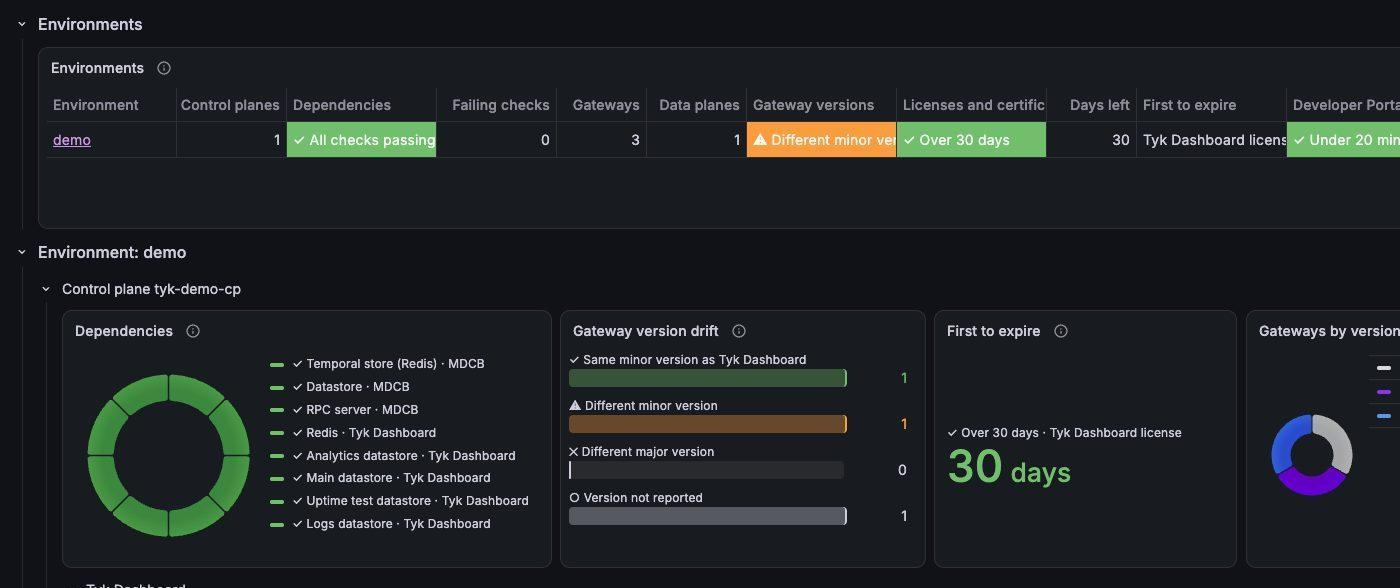
- Connectivity and data flow (MDCB 2.14.0). Which Tyk Gateways are connected, on which version and in which group, and whether configuration and analytics are flowing.
- Registry, health and governance (Dashboard 5.16.0). The Tyk Gateway registry, license usage, the health of the Dashboard’s own dependencies, and how many APIs meet your governance rules.
- Sync and health (Developer Portal 1.20.0). When the Tyk Developer Portal last synced with the Dashboard, and the health of its database and storage.
Everything exports over OpenTelemetry with the same configuration block the Tyk Gateway uses, to Grafana, Prometheus, ELK (Elasticsearch, Logstash, and Kibana), or any OpenTelemetry Protocol (OTLP) backend. Starter Grafana dashboards and alert rules are available, so the platform can tell you first. One platform lead put the requirement simply: "Don’t make me look at a screen."
Kubernetes, the standard way. Tyk Operator now supports the Kubernetes Gateway API. Platform teams can define routing with standard GatewayClass, Gateway and HTTPRoute resources, and the Operator turns them into Tyk APIs with full Tyk policy behind them.
Read the full story in Control plane observability with Tyk 5.16.
Govern smarter: change it once, apply it everywhere
The question: is the required change applied everywhere it should be?
Every organization has standards its APIs are supposed to meet: how they authenticate, which security headers they carry, how they report errors. When each API carries its own copy of that configuration, every change is repeated by hand across the estate, and drift between copies tends to surface in an audit or an incident.
An API Fragment holds configuration that can be shared by a group of APIs. Each API references the Fragment, so one edit updates all of them. Teams coming from other gateways will recognize the idea as shared flows; teams who live in OpenAPI will recognize it as an external reference, managed for you.
- A Fragment manager. Fragments get their own screen in the Dashboard, with the list of APIs using each one.
- Templates included. Fragments work in API Templates too, so new APIs inherit the shared pieces from day one.
- No accidentally broken APIs. Save a Fragment and the Dashboard validates every API that uses it. Anything that would produce an invalid definition blocks the save and names the affected APIs.
Use case: a central platform team owns the security headers, CORS policy, and standard error format for 200 APIs across a dozen product teams. The security team changes a header requirement. One Fragment edit, one validation pass, every API updated, and the Dashboard tells you if any API would have broken. Fragments are resolved in the control plane, so Tyk Gateways keep running on their current version while the central team starts using Fragments.
Access is decided by what’s in the request. Access rights on keys and policies can now go beyond path and method, and require the request to meet conditions, such as a query parameter, a header, or a field in the body. Take an endpoint that returns the caller’s own records, and somebody else’s when a user ID is provided in the request. Same path, same method, two very different privileges. The Tyk Gateway can now tell those two requests apart. Governance that lives in the platform scales with the estate.
Read the full story in API Fragments in Tyk 5.16: Defined once, governed everywhere.
Ready for agent execution with MCP 2.0
The question: will the agents calling our APIs still work after the next protocol change?
AI agents are moving from pilots into production, and the Model Context Protocol (MCP) they use to call tools has taken its biggest step yet. MCP 2.0, the specification published on July 28, 2026 (version 2026-07-28), makes the protocol stateless: the initialization handshake is gone and any instance can serve any request. That’s what lets MCP scale and be governed like the rest of your APIs. The open question for most teams is how to get there while agents are already running in production.
Tyk 5.16 supports MCP 2.0 in the Tyk MCP Gateway and makes adopting it simple. Both specification versions are served side by side on one gateway, with nothing to configure and nothing to migrate. Teams upgrade servers and clients when it suits them, and MCP 2.0 traffic is managed statelessly, so it scales out behind Tyk like any other API.
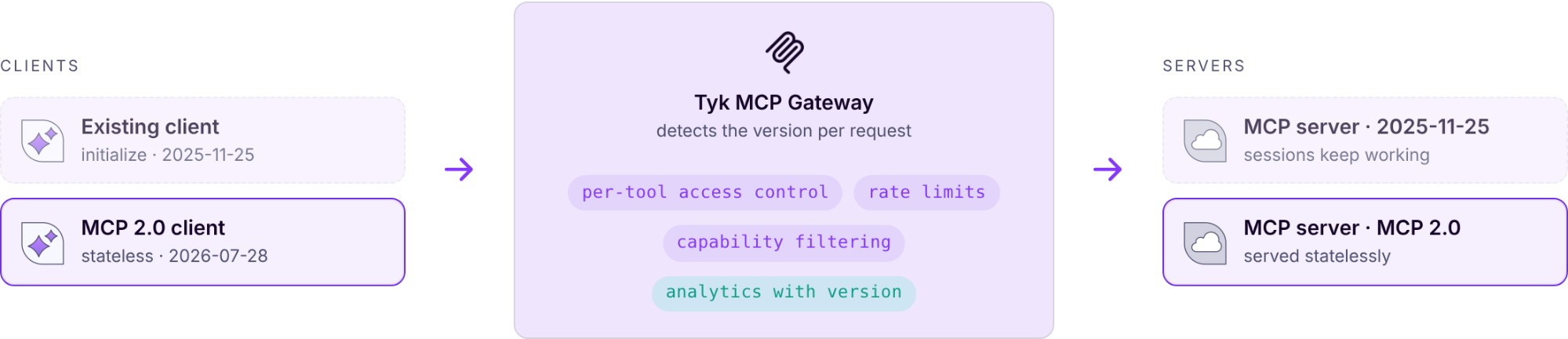
- Easy to adopt. API definitions pin no protocol version. Upgrade a server and the gateway serves MCP 2.0 on the next request.
- Governed the same way. Per-tool access control, rate limits, and capability filtering apply to both versions, and one consumer’s tool list never reaches another.
- Visible as it happens. Analytics show which specification version each request used, so you can watch adoption move through your own traffic.
The best thing a gateway can do with a protocol change is make it a question of timing. Your agents keep executing while your teams move to MCP 2.0 at their own pace. Governing the models your agents call matters just as much. Tyk AI Studio 2.2, now available, gives teams one governed endpoint for every approved LLM, with budgets, guardrails, and a full audit trail.
Read the full story in Built for scale: Tyk 5.16 brings stateless MCP to your gateway.
Control that keeps pace
Return to the three questions:
- Is my platform healthy right now? The control plane reports it, and an alert tells you first.
- Is this change applied everywhere it should be? One Fragment carries it, and the Dashboard lists every API that references it.
- Will our agents still work after the next protocol change? The gateway already serves MCP 2.0, statelessly, with your policies unchanged.
For the people who run the platform, that means faster answers and fewer escalations. Your estate will keep growing. With 5.16, your control over it grows with it.
Tyk 5.16 is available now. For the full list of features, fixes and upgrade guidance, check out the release notes in the Tyk documentation, or talk to your Tyk account team about planning the upgrade.
Frequently asked questions
What is control plane observability in Tyk?
Tyk Dashboard 5.16.0, MDCB 2.14.0 and Enterprise Developer Portal 1.20.0 export OpenTelemetry metrics covering gateway connectivity and versions, configuration and analytics flow, dependency health, and expiry. The metrics go to any OTLP backend, and starter Grafana dashboards and alert rules are available.
What are API Fragments in Tyk?
An API Fragment is a piece of shared configuration managed in the Tyk Dashboard and referenced by multiple API definitions and API Templates. Editing a Fragment updates every API that references it, and the Dashboard validates those APIs before saving. Fragments are resolved in the control plane, so your Tyk Gateways can stay on earlier versions. API Fragments are an Enterprise feature.
Does Tyk support MCP 2.0?
Yes. The Tyk MCP Gateway in Tyk Gateway 5.16.0 serves MCP 2.0 (the 2026-07-28 specification) side by side with the 2025-11-25 specification, with no configuration change. MCP 2.0 traffic is handled statelessly, and access control, rate limits, and capability filtering apply to both versions.