
The 2026-07-28 Model Context Protocol specification removed the session handshake and made MCP stateless. Tyk 5.16 serves the new version side by side with the old one, on one gateway, with nothing to configure.
The "boring" moment every protocol goes through
There is a moment in every technology’s maturity journey when it stops being the shiny new thing and starts becoming "boring". It’s the path to scalability through reliable predictability. HTTP reached it when nobody needed to explain what a load balancer was for. TLS reached it when certificates became something a pipeline renews on a Tuesday. The shiny phase is where early adopters live, swapping workarounds and arguing about edge cases. The boring phase is where platform teams take over and the technology becomes infrastructure you can build on.
On July 28, 2026, MCP had that moment. The new specification is the best thing that could have happened to it. If you run an API platform, it’s also the best thing that could have happened to you.
What the spec changed
Until July 28, an MCP client opened with a multi-round-trip initialization handshake, received a session ID, and repeated that ID on every call. The handshake was how the client learned the server’s version and what it offered (tools, resources, and prompts). It worked, and it made MCP stateful in a way that sat awkwardly next to everything else a platform team runs. Scaling it meant sticky routing or a shared session store. Putting a load balancer in front of it was a project.
The 2026-07-28 spec removes the handshake entirely. Every request carries its protocol version in _meta and in headers, while every response carries capability metadata. Servers retain a dedicated server/discover endpoint to advertise their capabilities. Any instance can serve any request, and one server may accept both styles at once. Around that headline, the spec did some housekeeping:
- New: caching hints on list results,
Mcp-MethodandMcp-Nameheaders, multi-round-trip requests, streams on the POST response, stricter OAuth issuer checks. - Removed: ping, log level setting, stream resumption, and error code -32002.
- Deprecated with at least 12 months of runway: roots, sampling, logging, the older HTTP+SSE transport, and dynamic client registration in favor of client ID metadata documents.
The spec also reorganized itself into a core protocol plus optional extensions, which is what a protocol does when it expects to be around for a while.
Why platform teams should be pleased
MCP now fits the infrastructure you already have. Load balancers work. Autoscaling works. Request-level observability works, because each request and response can be read in complete isolation. An MCP server is an HTTP service that your platform can own, govern, and scale like any other API, with the sticky, session-shaped exception removed.
That matters for a reason beyond convenience. For the previous year, MCP had mostly been run by the people who were excited about it: AI teams, prototypers, the engineer who built the first server over a weekend. Those are the wrong people to be on call for it. A stateless MCP is one the platform team can take off their hands, put behind the same gateway as everything else, and hold to the same standards.
MCP is for platform teams now. That was always where it needed to end up.
Our approach: both versions, side by side, no migration
When we designed the Tyk MCP Gateway, we knew the protocol would change. We didn’t know how, only that it would, and that it would keep doing so. So the design goal from the start was spec transparency: support every version we claim to support, side by side, with zero input from the operator. Upgrade a server to the new spec and the gateway respects the new version on the next request. Roll it back and the gateway respects that too.
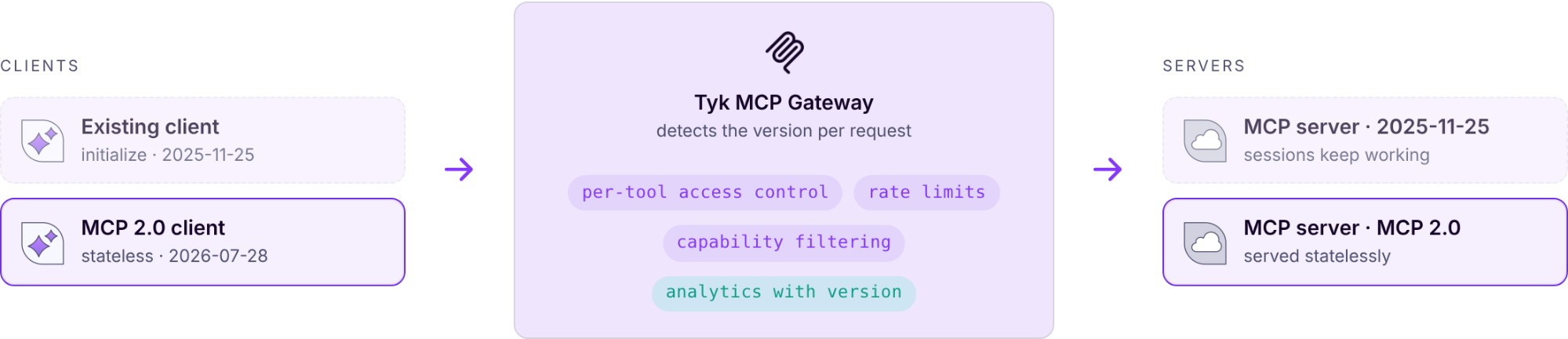
In Tyk 5.16, that means three things:
Nothing to configure. API definitions pin no protocol version. The gateway detects each request’s style at the front door. A handshake-free request is routed, authenticated, and rate-limited exactly like an old-style one, with no synthetic session created to fake it.
Enforce on the body. Method and tool name are still read from the request body; headers only corroborate. If the header version and the _meta version disagree, or Mcp-Method and Mcp-Name disagree with the body, the request is rejected with a 400. A call declaring 2026-07-28 in _meta without the version header is also rejected. A request declaring no version is accepted and treated as 2025-03-26, preserving compatibility with older clients. A disagreement is never guessed at.
Your governance holds. Per-tool access control, rate limits, and capability filtering apply identically whichever version the client speaks. The policy that strips denied capabilities from initialize now applies to server/discover as well. One rule, every version.
The sharp edges we took off
One consumer’s tool list never reaches another. The new spec lets an upstream mark tools/list results as safe for shared caches. That’s a sensible hint for a server to give, and it becomes wrong the moment a gateway edits the response. Tyk filters tool lists per credential; it’s one of the things Tyk customers value most. So the gateway intercepts the caching hint and stamps anything it has edited as private. That covers JSON and SSE responses, every page of a paginated list, and keeps each credential’s tool order stable. Lists that pass through unfiltered keep the server’s hint.
Origin validation against DNS rebinding. Every MCP Streamable HTTP endpoint now checks the Origin header, as the spec requires. Requests with no Origin (non-browser clients) and requests from the same or a trusted origin are accepted; anything else gets a 403 before authentication or quota are touched. Wildcard CORS is no longer treated as an MCP allow-all.
Protocol version in analytics. Every MCP analytics record shows which spec version the request used. Adoption of the new spec becomes something you can watch in your own traffic, per server, per consumer, rather than something you read about.
Error codes and OAuth compliance. The spec retired the error code Tyk used for access denied and reserved a band for its own use, so new-style traffic gets Tyk codes outside that band while old-style traffic keeps today’s codes. Mirrored OAuth metadata now names Tyk as issuer, so strict clients pass their new issuer checks, OAuth discovery calls drop a header the spec never applied to them, and an upstream "record not found" is no longer reported to the client as "method not found".
REST as MCP and the Tyk Developer Portal
When Tyk exposes a REST API as an MCP server, the gateway runs an embedded Go SDK. That SDK is either stateful or stateless, with no single mode that does both. So the gateway now runs two handlers over one tool catalog and routes each request by its detected version. Old-style clients keep their sessions. New-style clients are served natively rather than negotiated down. There is no per-API version setting, and when a new-style client disconnects mid-call, the underlying REST request is canceled too, so an abandoned tool call stops consuming resources upstream.
In the Enterprise Developer Portal, the interactive playground on an MCP product’s docs page moves to MCP Inspector V2. V2 is a different architecture, a bridge rather than a proxy, so the portal serves its backend natively in Go with no Node runtime and no sidecar, and it can only reach its own product’s MCP server. You can opt-in with a single setting, and V1 stays mounted, so switching back is a configuration change rather than a redeploy.
The portal also closes a previously open loop. Portal-issued credentials now carry the OAuth scopes an API requires. The portal reads each API’s required scopes from its OpenAPI security block at every sync, adds them to the token at access-request time, lets admins narrow the set per product (selection only subtracts, never adds), shows the scopes on the credential card, and catches misconfigured auth at save time with a message naming the fix. Developers make no scope decisions at all. Publishing an MCP server to a portal with full OAuth, including the scopes the server requires, is now a complete path from catalog to first call.
A non-event
From a user’s point of view, the MCP spec upgrade in Tyk 5.16 looks like nothing happened. Servers upgraded, clients upgraded, traffic kept flowing, the same policies kept applying, and the only visible change is a new value in the protocol version column of your analytics. That’s the whole point. The best thing a gateway can do with a protocol change is make it a non-event, and the best thing a protocol can do for its users is become boring enough that the platform team takes it off the engineers’ hands. MCP got there in July 2026. Your gateway was ready for it before you noticed.
Tyk 5.16 is available now. The MCP Gateway reference is in the Tyk documentation, and the full spec changelog is at modelcontextprotocol.io.