

How to govern AI agent access to APIs: Authentication, audit trails, and zero-standing trust
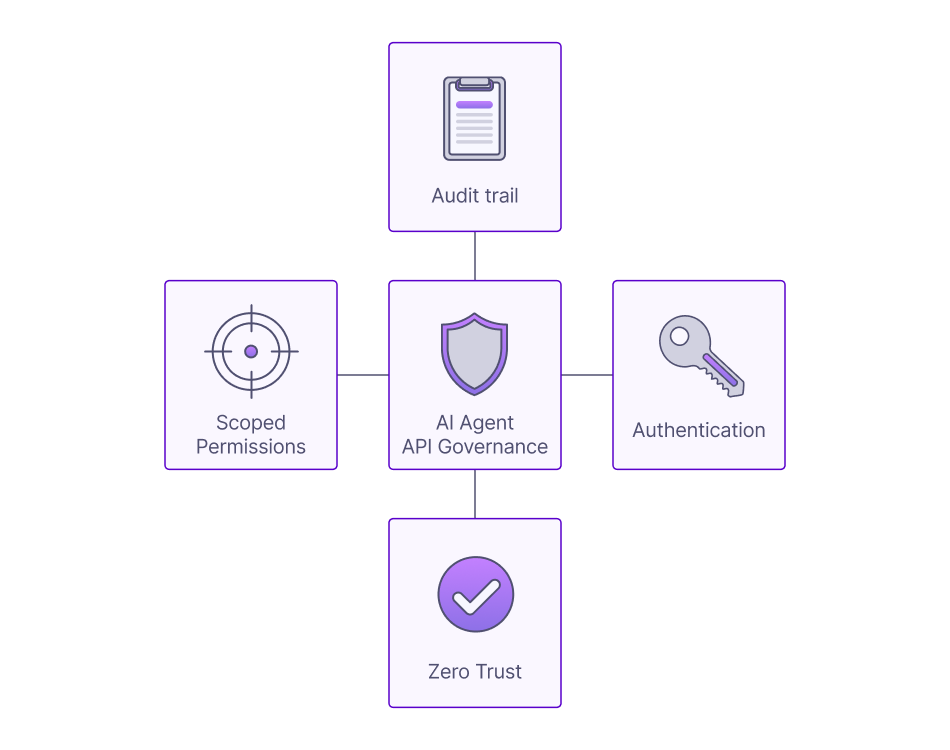
Need to govern AI agent access to your APIs? Then authentication, audit trails, and zero-standing trust will all be on your priority list. We’ll walk you through each of them in this guide, covering critical elements you’ll need to factor into your agentic AI risk management approach:
- AI agents that inherit human credentials bypass auditability, violate least privilege, and operate at machine speed with human-level permissions. Enterprises must put a stop to this security antipattern.
- Zero-standing trust requires agents to request scoped, short-lived credentials for each task, authenticated through OAuth 2.1 and verified at the API gateway.
- Every agent API call needs an audit trail that ties the action to a specific agent identity, the delegating user, the granted scope, and a timestamp.
- The MCP specification now includes OAuth 2.1 authorization, but securing agent-to-API access remains an active problem that demands centralized governance through an API gateway with policy enforcement.
Why is AI agent API access a security problem?
Granting AI agents access to enterprise APIs without dedicated governance is a structural security failure. According to Noma Security research, the top blind spots in AI agent deployments include lack of observability and overly broad permissions. Both problems compound in multi-agent structures when agents operate autonomously across dozens of API integrations.
Consider the scale. A department with 50 agents, each needing keys for Slack, Jira, GitHub, a CRM, and a dozen internal APIs, has recreated the pre-SSO era. Except now, access is autonomous and operates at machine speed. Every credential is a static secret. Every secret is a lateral movement vector.
In our experience building API governance infrastructure at Tyk, the pattern is familiar. It mirrors the early days of microservices, when teams baked database credentials into every service config instead of centralizing credential management. The fundamental difference is that AI agents amplify the blast radius. A single compromised agent can pivot across every API it holds keys for, and a single compromised MCP server can impact dozens of connected systems.
The enterprise attack surface includes three layers: The agent runtime, the protocol layer (MCP or custom), and the downstream APIs. Designing API governance for both human and machine consumers must cover all three.
What happens when AI agents use your credentials?
The most common pattern today is the CLI antipattern, where an AI agent authenticates to APIs using the human operator’s credentials. The agent runs CLI commands, makes HTTP requests, and calls tools, all as the user. This is the default in most LLM-powered coding assistants and automation frameworks.
As security practitioners have observed in production deployments, the LLM has the same permissions as you. This is a significant issue for your privacy and confidentiality commitments. It can leak your secret by making a curl request. And it prevents AI auditing entirely, since the system records the human’s identity, not the agent’s. You lose zero-standing trust, auditability, and minimum access scoping in a single design choice.
What the CLI antipattern breaks:
Security principle | How the CLI antipattern violates It |
Least privilege | Agent inherits full human permissions, not task-scoped access |
Auditability | Logs show human identity, not agent identity or action context |
Zero-standing trust | Agent holds persistent credentials with no expiry or scope limit |
Credential isolation | Leaked agent secret exposes the human’s full access |
Revocation | Cannot revoke agent access without revoking the human’s access |
This pattern persists because it is easy. Agents inherit existing tooling, existing auth, and existing permissions. But at enterprise scale, easy becomes dangerous.
How does zero-standing trust apply to AI agents?
Zero-standing trust means no agent holds persistent access to any API. Every access request is evaluated, scoped, and time-bound. The agent starts each task with zero permissions and must request exactly what it needs.
For AI agents, this translates to three concrete requirements:
- Credentials are issued per-task, not per-agent. An agent building a deployment pipeline gets write access to the CI/CD API for that specific pipeline and nothing else.
- Credentials expire. Short-lived tokens (minutes, not days) limit the blast radius of any compromise.
- Every credential issuance is logged with the delegating user’s identity, the agent’s identity, and the granted scope.
The architectural parallel is the service mesh model. As practitioners building agent infrastructure have proposed: Deploy a service mesh with Open Policy Agent (OPA) for policy enforcement, where the gateway owns the credentials. The agent never sees downstream API keys. The gateway mediates every request, enforces scope, and logs the full context.
In practice with Tyk API Gateway, this means configuring RBAC policies that bind agent identities to specific API paths and methods, with token time-to-lives (TTLs) measured in minutes. The gateway becomes the policy enforcement point, not the agent runtime.
How should enterprises authenticate AI agents to APIs?
Agent authentication must separate identity from access. The agent has its own identity. The human who delegated authority has their own identity. The access token binds both to a specific scope and TTL.
Here are the primary authentication patterns for AI agent deployments:
Auth pattern | How it works | Best for | Limitations |
OAuth 2.1 client credentials | Agent authenticates as a service client with scoped grants | Server-to-server agent flows | No user context in token |
OAuth 2.1 plus delegation (token exchange) | Agent exchanges user token for a scoped agent token via RFC 8693 | User-delegated agent actions | Requires token exchange support |
Remote MCP with SSO | Agent authenticates via OAuth/SSO to MCP server; server holds downstream keys | Multi-tool agent platforms | MCP server becomes trust boundary |
Cryptographic warrants | Task-scoped, delegation-aware tokens verified at tool boundary | High-security environments | Custom implementation required |
API gateway with OPA | Gateway enforces per-request policy; agent never holds downstream keys | Centralized governance | Requires gateway in request path |
The MCP specification now mandates OAuth 2.1 for HTTP-based transports, with support for PKCE, dynamic client registration, and scope-based access control. But the spec covers the client-to-MCP-server leg only. Securing the MCP-server-to-downstream-API leg requires additional infrastructure.
Remote MCP servers change the credential management equation. The agent authenticates via OAuth or SSO, the MCP server holds downstream API keys, and the user never handles them directly. Disable the SSO account and every connected agent loses access instantly. This is the same pattern that solved credential sprawl in the SaaS era – centralized identity with federated access.
What does an AI agent audit trail look like?
Every AI agent API call must produce an audit record that answers five questions:
- Who delegated?
- Which agent acted?
- What did it access?
- When?
- Why?
Without this, incident response is guesswork. A complete agent audit trail captures the following fields:
Audit field | Description | Example |
agent_id | Unique identifier for the agent instance | agent-deploy-bot-7f3a |
delegating_user | Human who authorized the agent | |
session_id | Task or conversation session identifier | sess-2026-03-25-a8c2 |
api_endpoint | Target API path and method | POST /api/v1/deployments |
scope_granted | OAuth scopes or RBAC permissions active | deployments:write, logs:read |
token_ttl | Time-to-live of the access token | 300s |
timestamp | UTC timestamp of the request | 2026-03-25T14:22:07Z |
request_context | Agent-provided reason or task description | Rolling deploy to staging |
mcp_server | MCP server that mediated the request (if applicable) | mcp.internal.company.com |
policy_evaluation | OPA or gateway policy decision | ALLOW — policy deploy-staging-v2 |
WorkOS reports that MCP pilot programs stall in enterprise environments when three conditions exist: permissions are overly broad, actions cannot be traced to an individual, and agents accumulate more access than intended. The audit trail directly addresses the second condition, and it feeds the data needed to detect the first and third.
With Tyk API Gateway, every proxied request generates detailed analytics including the key identity, policy applied, endpoint hit, and response code. When the key identity maps to an agent rather than a human, you get agent-level auditability out of the box.
How does MCP handle agent authentication and authorization?
The Model Context Protocol specification now includes an OAuth 2.1-based authorization framework for HTTP transports. MCP clients act as OAuth clients, MCP servers act as resource servers, and a separate authorization server handles token issuance. The spec requires PKCE, supports dynamic client registration, and mandates resource indicators (RFC 8707) to bind tokens to specific MCP servers.
The authorization flow follows standard OAuth patterns: the client receives a 401, discovers the authorization server via protected resource metadata (RFC 9728), performs the OAuth dance, and attaches bearer tokens to subsequent requests. Scope challenges allow step-up authorization when an agent needs additional permissions mid-session.
But MCP authorization has known gaps, which made early implementations genuinely painful for security teams. And securing MCP remains an open problem. The spec covers client-to-server auth but doesn’t define how MCP servers should authenticate to downstream APIs, how to propagate the delegating user’s identity through the chain, or how to enforce cross-server policy consistency.
The supply chain risk is also real. Malicious MCP servers with names near-identical to trusted packages can intercept agent traffic. Proofpoint research highlights that MCP’s trust model assumes server integrity; a single compromised server in an agent’s tool chain can exfiltrate data from every connected system.
For production deployments, this makes layering an MCP native API gateway in front of MCP servers essential. The gateway validates tokens, enforces rate limits, applies governance policies, and generates the audit trail. The MCP server handles tool logic. The gateway handles security.
What are the biggest AI agent security risks today?
The threat landscape for AI agent API access includes five primary risk categories, ordered by likelihood of exploitation in current enterprise deployments.
- Credential inheritance. Agents using human credentials have full account access. A prompt injection or tool misuse can exfiltrate secrets, modify data, or pivot laterally, all logged under the human’s identity.
- Permission accumulation. Agents that acquire API keys over time accumulate access far beyond any single task’s requirements. Without automated credential rotation and scope review, agent permissions only grow.
- Lack of observability. Most agent frameworks produce minimal logging. When an agent makes 200 API calls in 30 seconds, security teams need per-call attribution, not a single session log entry.
- MCP supply chain attacks. The MCP ecosystem lacks a verified package registry. Malicious servers with typosquatted names can intercept tool calls and exfiltrate tokens, API responses, or user data.
- Unscoped delegation. When a user grants an agent access to “do the deployment,” the agent interprets scope at runtime. Without explicit scope boundaries enforced at the gateway, the agent’s interpretation becomes the effective permission set.
What should security teams implement first?
Start with the API gateway as the control point. Before rearchitecting agent auth flows, put every agent API call behind a gateway that enforces identity, scope, and logging.
Phase 1 (weeks 1-2): Visibility. Route all agent API traffic through Tyk API Gateway. Create dedicated API keys for each agent. Enable detailed request logging. You now have a baseline of what agents are actually accessing.
Phase 2 (weeks 3-4): Scope enforcement. Apply RBAC policies that restrict each agent key to specific API paths and methods. Set token TTLs to hours, not days. Deny by default.
Phase 3 (month 2): Identity propagation. Implement OAuth 2.1 token exchange so that agent tokens carry both the agent identity and the delegating user identity. Integrate OPA for policy-as-code evaluation at the gateway.
Phase 4 (month 3+): Zero-standing trust. Move to per-task credential issuance. Agents request scoped tokens from the gateway for each task. Tokens expire after the task completes. Audit trails capture the full delegation chain.
Each phase delivers incremental security value. Phase 1 alone eliminates the observability gap for most teams
A five-step framework for implementing agent governance
We can break down agentic governance implementation into five steps. Follow them to achieve a well-governed, reliable infrastructure that helps mitigate risk and keeps your enterprise running smoothly and your regulators happy.
Step 1: Define scope and authority (the design phase)
Start by making delegation explicit. Every agent must have a clearly defined purpose, a bounded set of actions, and an identifiable owner. This is where most governance failures originate, with agents deployed with vague mandates like “manage deployments” or “handle tickets,” leaving scope interpretation to the runtime. In distributed agent environments, this ambiguity scales quickly.
Instead, clearly define, which APIs the agent can access, what actions it can perform (read, write, execute), and which human roles are allowed to delegate to it. This creates the contract between human intent and agent capability. Without it, you can’t enforce least privilege downstream.
Step 2: Configure identity and access policies (the gateway setup)
Once you’ve defined scope, translate it into enforceable policy at the API gateway. Each agent gets a unique identity, separate from any human user. Access is granted through scoped policies, not shared credentials.
In practice, this means creating per-agent API keys or OAuth clients, mapping each identity to specific API paths and methods, and defining token lifetimes and default-deny policies. The gateway becomes the source of truth for access control. Agents no longer “own” permissions; policies do.
Step 3: Establish runtime guardrails (policy enforcement)
Static policies aren’t enough. Agent behavior must be constrained at runtime, where decisions are made per request. This is where policy-as-code frameworks like OPA integrate with the gateway to evaluate context dynamically across distributed systems.
Guardrails should include rate limiting to prevent runaway execution, context-aware authorization (user, agent, task), schema validation and request inspection, and automatic denial of out-of-scope actions. This ensures that even if an agent attempts an unintended action, enforcement happens before the request reaches the downstream API.
Step 4: Implement traceability and logging (observability)
Governance without visibility fails in production. You need to monitor every agent action and ensure it’s traceable not just at the session level but at the individual API call level, especially when agents orchestrate multi-step workflows across systems.
At minimum, logging must capture agent identity and delegating user, request details (endpoint, method, payload context), policy decisions and applied scopes, and timestamps and token metadata.
This data forms the audit trail required for incident response, compliance, and continuous policy tuning. Over time, it also enables detection of anomalies such as unusual access patterns, semantic drift in agent behavior, or permission creep.
Step 5: Enforce continuous verification (reliable zero-standing trust in practice)
Zero-standing trust is not a one-time configuration. It’s a continuous process of verification at every request boundary. Every token must be revalidated, every scope rechecked, and every policy re-evaluated in real time.
In practice, this means agents never reuse credentials across tasks, policies are enforced per request (not per session), and access decisions incorporate context, including user identity, agent type, and task intent.
The API gateway becomes the enforcement loop. It validates tokens, evaluates policy, logs the decision, and expires access automatically. This closes the gap between authentication and runtime behavior, ensuring that access remains tightly scoped even as agent activity scales.
Emerging protocols: A look at MCP and A2A
Agentic systems are driving the development of new interoperability protocols, with Model Context Protocol (MCP) and Agent-to-Agent (A2A) communication emerging as the primary standards. It’s important to understand the differences between the two and why each is needed.
MCP focuses on connecting agents to tools and data sources through a structured interface. Its adoption of OAuth 2.1 is a critical step toward standardizing authentication, but it stops short of defining full governance. The responsibility for downstream API security, policy enforcement, and auditability still sits with the enterprise.
A2A protocols extend this model by enabling agents to interact directly with each other. This introduces a new layer of complexity. Instead of a single agent accessing APIs, multiple agents can chain actions together, each inheriting or delegating context. Without strict governance, this creates transitive trust risks, where one compromised agent can influence others across the system.
To manage this, enterprises must treat protocols as transport layers, not trust layers. Governance cannot be delegated to MCP or A2A alone. It must be enforced externally through a centralized control plane: the API gateway.
By placing the gateway in front of MCP servers and A2A interactions, organizations can:
- Apply consistent authentication and authorization policies across all agents
- Inspect and validate every request, regardless of origin
- Enforce rate limits and anomaly detection at the system level
- Generate unified audit trails across multi-agent workflows
The pattern is consistent with earlier shifts in distributed systems. Just as service meshes standardized service-to-service communication without replacing security controls, MCP and A2A standardize agent interaction without solving governance. Protocols enable agents to operate; gateways govern how they operate.
Frequently asked questions
Can AI agents use the same OAuth flows as human users?
Agents should not use interactive OAuth flows designed for humans. Instead, use the OAuth 2.1 client credentials grant for autonomous agents, or the token exchange flow (RFC 8693) when an agent acts on behalf of a user. The MCP specification supports both patterns. The key difference is that agent tokens must carry agent-specific identity claims and be scoped to the minimum permissions required for the current task, not the full permission set of the delegating user.
How do you revoke AI agent access across multiple APIs?
Centralize agent identity through SSO and an API gateway. When an agent’s SSO account is disabled, every downstream API session terminates. With remote MCP servers, this happens automatically; the MCP server validates the agent’s SSO session on each request. Without centralization, you must revoke each API key individually across every service, which at enterprise scale is operationally infeasible.
What is the difference between MCP authentication and API gateway authentication?
MCP authentication covers the link between the MCP client (the agent) and the MCP server (the tool provider), using OAuth 2.1. API gateway authentication covers the link between any client and the downstream API, enforcing rate limits, scope, identity, and governance policy. In production, you need both. The MCP server authenticates the agent. The API gateway authenticates and authorizes the MCP server’s requests to downstream APIs, providing a second enforcement layer and a unified audit trail.
Is it safe to give AI agents long-lived API keys?
No. Long-lived API keys for agents violate zero-standing trust and create persistent attack vectors. If the key is exfiltrated through a prompt injection, tool vulnerability, or log exposure, the attacker has indefinite access. Use short-lived tokens (minutes to hours), enforce rotation, and require re-authentication for sensitive operations. Tyk API Gateway supports token TTL configuration and automatic expiry enforcement at the gateway level.
Start governing your AI agent API access today
Tyk’s API gateway provides centralized auth, RBAC, rate limiting, and per-request audit logging for both MCP and REST API traffic. Learn how Tyk is shaping MCP security in practice and speak to the team to find out more.