"Are we compliant with our API standards?" It’s the kind of message that lands in a platform team’s Slack on a Monday morning and sounds like it needs a ten-minute reply. In the API estates we studied while building this release, the honest reply took about a week. Somebody dug out the standards document, somebody else pulled the list of APIs, and a small team worked through them one by one. By the time the answer came back, new APIs had already shipped.
What strikes me about that story is that everyone did good work. The standards were sensible and the reviewers were sharp. The estate had simply grown from dozens of APIs to hundreds, and the team looking after it had stayed the same size.
Tyk has always governed how your APIs run: policies, authentication, rate limiting, analytics and, through Tyk AI Studio, how AI consumes them. Tyk Governance, new in Tyk 5.15.0, adds the layer that comes before all of that: whether an API meets your standards before it goes live, and whether the whole portfolio stays in line as it grows. Same platform, same permissions, one more place to look.
The aim is to make API governance the accelerator, not the brakes. While building it, we kept running into the same four challenges, so here’s how I’ll walk you through them: the challenge, what we set out to solve, and how Tyk Governance handles it.
At a glance
| The challenge | What shipped in 5.15.0 |
|---|---|
| Nobody can answer "are we compliant?" | Compliance status and filter in the API list, an organization-wide overview banner, a Governance tab on every API, a home page notice when anything drifts, all fed by automatic evaluation on save, update and rule change. |
| Standards drift as more teams ship | Rulesets scoped by API Category so every API in scope is held to the same standard; Read, Write and Deny permissions; the same evaluation from GitHub Actions, GitLab CI, Jenkins and Tyk Operator 1.5.0. |
| Spec linting sees half the API | Rules cover the OpenAPI spec and the Tyk Gateway configuration in one pass; import Spectral rulesets unchanged, write your own, or start from a community template. |
| Governance as a gate gets bypassed | Error, Warn and Info severities, remediation guidance on every issue, a test panel, a per-ruleset Deployment Warning that is off by default and leaves the decision with the API owner. |
1. Nobody can answer "are we compliant?"
The challenge. Manual review works at 50 APIs and breaks at 500. Every check is a person reading a spec against a document, and the estate grows faster than the headcount. So the answer is always a snapshot, and by the time it arrives, it’s out of date.
What we’re solving for. An answer the platform lead can get in seconds, which stays current as APIs and rules change.
How Tyk Governance handles it. The answer sits where you already look. The API list now shows a compliance status for each API, a filter for compliant and non-compliant, and an overview banner with totals for the organization. Each API gets a Governance tab with error and warning counts, a card for every ruleset that applies, and a filterable table of issues. If an API drifts to non-compliant, a banner on the Dashboard home page tells you straight away. Underneath, nobody is running checks by hand. Save an API, and it’s evaluated on the spot. Updating an API that a ruleset already applies to triggers an evaluation asynchronously the moment you save. Change a ruleset and every affected API is re-evaluated in the background. Evaluation runs on the control plane, well away from your traffic, so it adds nothing to a request.
2. Standards drift as more teams ship
The challenge. More and more teams define and ship APIs as code through their own pipelines. That’s real speed, and it also removes the one checkpoint that used to sit between a spec and production. More team ownership means less central visibility, and the standards that live in a wiki get applied a little differently by every team that reads them. Was that rate limit 250 or 240? Did staging get the same auth setting as production? Gaps surface at an audit or an incident rather than a design review.
What we’re solving for. Centralized standards without centralized control. Platform teams define the rules once, and every team’s APIs meet the same standard without anyone having to remember to run a check.
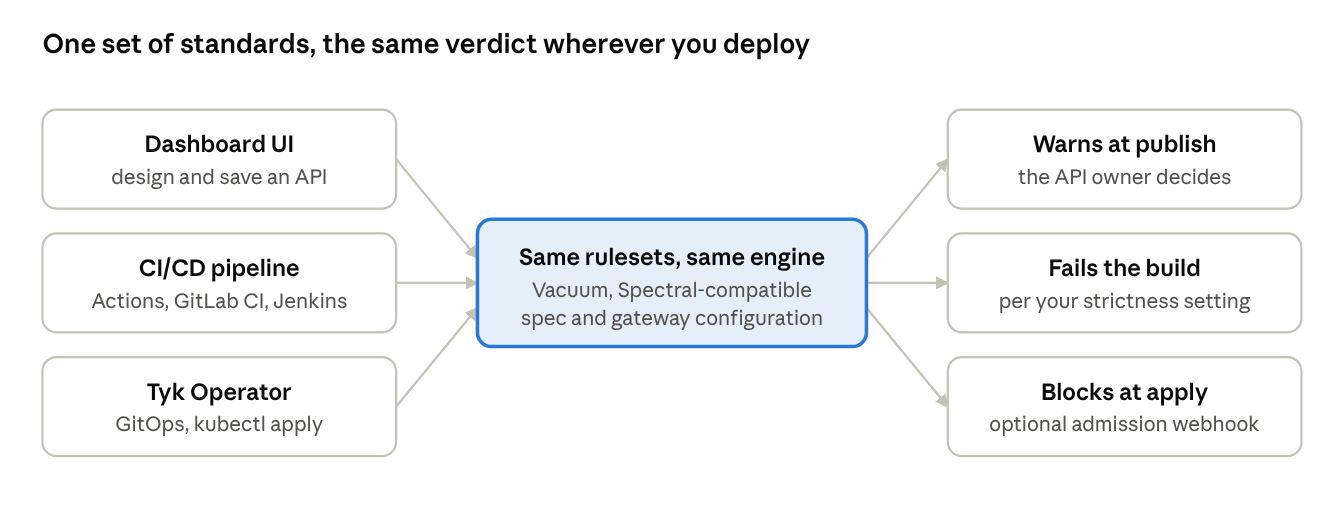
How Tyk Governance handles it. Standards live as rulesets, and a ruleset is scoped to the API Categories you already use to organize your estate. Every API carrying that category is in scope, and any API that picks up the category later is in scope automatically. A Governance permission group with Read, Write and Deny levels separates the people who define the standards from the people who build to them. The same rulesets run wherever an API comes from. A pipeline can call a sandbox evaluation endpoint with an OpenAPI file from GitHub Actions, GitLab CI, Jenkins or anything else that can make an HTTP call, and get back every issue with its location and its fix. Teams on Tyk Operator 1.5.0 keep rulesets in Git next to their APIs as TykRuleset resources and get the same verdict at kubectl apply.
One standard, however your teams ship. One set of standards, the same verdict wherever you deploy: Dashboard, CI pipeline or Tyk Operator.
3. Spec linting sees half the API
The challenge. Most API linting stops at the OpenAPI spec. That’s useful, and it’s also half the picture. Authentication settings, rate limits and the rest of the gateway configuration live in a layer spec-only linters never see, and it’s the layer where two APIs with identical specs end up behaving differently in production. In one estate we looked at, most APIs had no standalone spec at all, so a spec linter would have had nothing to read.
What we’re solving for. One set of rules that covers the whole API, contract and runtime configuration together, built on the governance work your team has already done.
How Tyk Governance handles it. A Tyk OAS API definition is the OpenAPI description plus the Tyk extension that holds the gateway configuration, so every API you manage in Tyk has something to check, and one ruleset checks both halves in the same pass. Bring your existing Spectral rulesets across unchanged, or write your own for internal conventions and Tyk-specific settings. To get a first result quickly, start from a community template: OWASP API Security for a security baseline, or the OpenAPI best practices rules for naming, documentation, and consistency. Those templates come from the Spectral community, so treat them as a starting point and shape them to your own standards; the editor lets you disable rules, change severities and rewrite the guidance before you save. Rulesets run on Vacuum, a Go-based engine that’s fully compatible with the Spectral format and built for speed on large specs.
4. Governance as a gate gets bypassed
The challenge. A gate creates a queue. Reviews take days, so developers wait. Waiting creates friction, so teams find ways around the review, and those workarounds put unchecked APIs into production, which is precisely the outcome the gate existed to prevent. AI speeds up the loop from both ends: coding assistants write APIs faster than any review board can read them, and Gartner expects AI agents to be the main consumers of enterprise APIs by 2028, making consistent, documented, properly authenticated APIs a prerequisite rather than a nicety.
What we’re solving for. A compliant path that’s easier than the workaround. The customers we built this with put it plainly: telling someone no is unhelpful on its own; they need "no, and here is what to do instead".
How Tyk Governance handles it. Every rule carries a severity: Error, Warn, or Info. Only Error-level failures make an API non-compliant. Warn and Info are advisory, so you can raise the bar gradually while teams adjust. Each issue comes with remediation guidance alongside the rule, covering what failed, why it matters, and how to fix it, and developers see it in the API designer while they’re still building. A test panel lets anyone dry-run a ruleset against an API before it counts. Tyk Governance never hard-blocks a save or a deployment in the Dashboard. Where you want a stronger nudge, a per-ruleset Deployment Warning flags non-compliance at publish time and the API owner decides whether to go ahead. It’s off by default. In the pipeline, a strictness setting decides whether a build fails, and Operator offers an optional admission webhook for Kubernetes teams who want a hard stop at kubectl apply.
A block a team chooses at the point where it owns the pipeline is a different thing from a central gate everyone queues behind. A warning that comes with a fix changes behavior; a gate teaches people to avoid governance.
Getting started
Tyk Governance is available on Tyk Enterprise and enabled per organization. If you’re already a customer, ask your account manager to switch it on, and the quick start will take you from your first ruleset to your first compliance view in a few minutes. If you’re evaluating Tyk, talk to us.
So the next time "quick one: are we compliant?" lands on a Monday morning, you can reply before your coffee goes cold.