

Availability
The Asset Catalog is an Enterprise plugin that keeps a governance record of the AI assets that your organization builds and uses. AI Studio does not proxy these assets itself. Examples are agents, prompts, business applications, and integrations between two systems.
For each asset, the catalog records:
- Who owns it and who is accountable for it.
- Its versions and the reason for each change.
- Its lifecycle stage, from draft to retired.
- What it depends on: other assets, and the LLMs, tools, data sources, MCP servers, routers, and Apps of AI Studio.
- Its risk tier, calculated from those dependencies.
Requirements
- AI Studio Enterprise Edition v2.2.1 or later, with a valid Enterprise license. Without a valid license, the plugin stops at start-up.
- To publish events for other plugins, AI Studio must run with
GATEWAY_MODE=control. Instandalonemode, the catalog works, but it does not publish events.
Install the Plugin
- In the admin console, go to Plugins > Marketplace.
- Find Asset Catalog (Enterprise) and install it. If the marketplace does not show version 1.2.0, add the plugin with the OCI command
oci://docker.tyk.io/studio-plugins/asset-catalog:1.2.0. Refer to Deployment Options. - Approve the service scopes that the plugin requests. The plugin needs these scopes to read AI Studio objects, register its permissions, and suspend Apps. When you upgrade from 1.1, AI Studio asks you to approve the new scopes.
- Make sure that the plugin is active. The admin sidebar then shows an Asset Catalog section, and the AI Portal shows an Asset Catalog section.
Asset Types
An asset type defines a class of assets. It sets the fields of the asset, the protected fields, and the lifecycle rules. To manage types, go to Asset Catalog > Asset Types.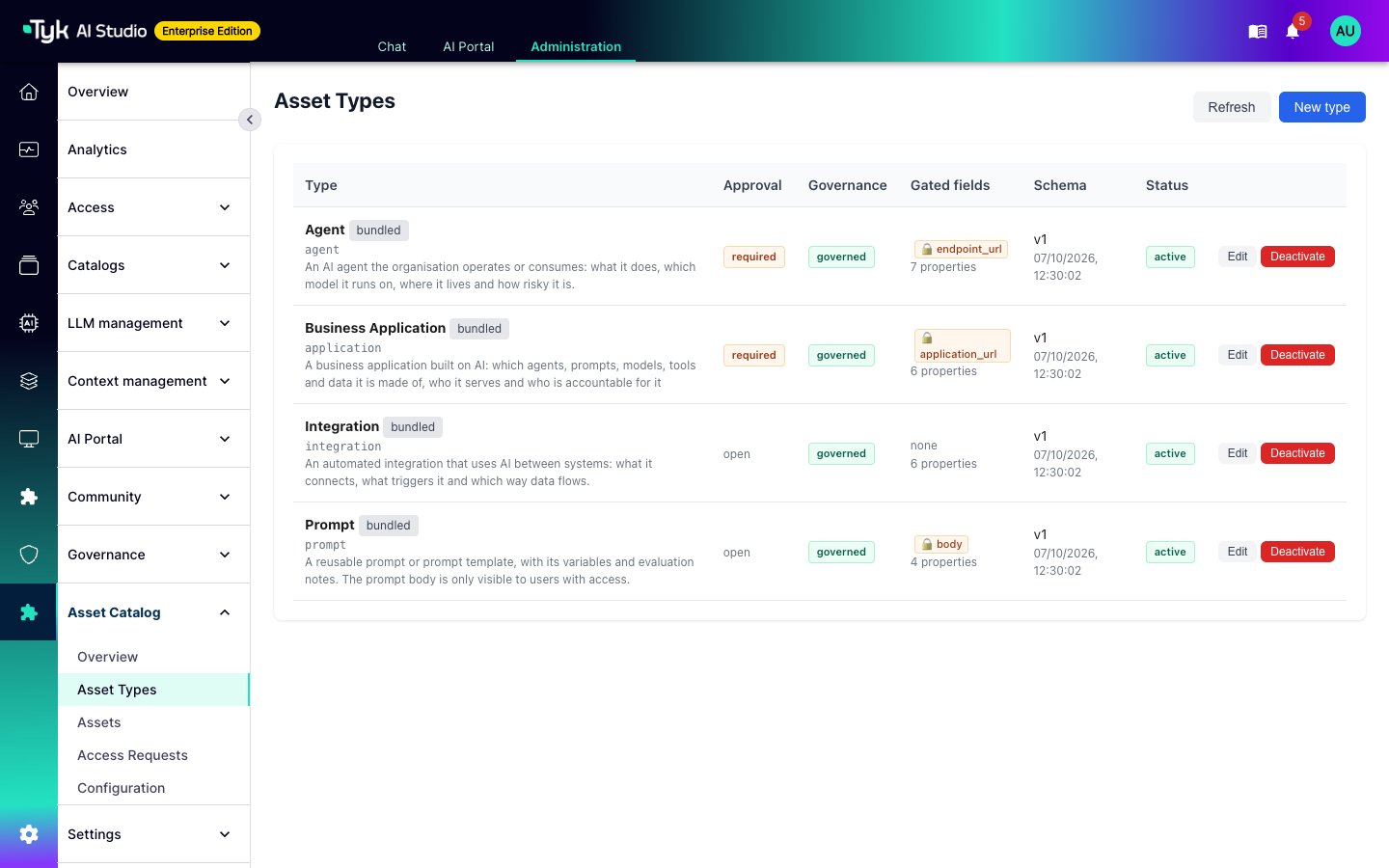
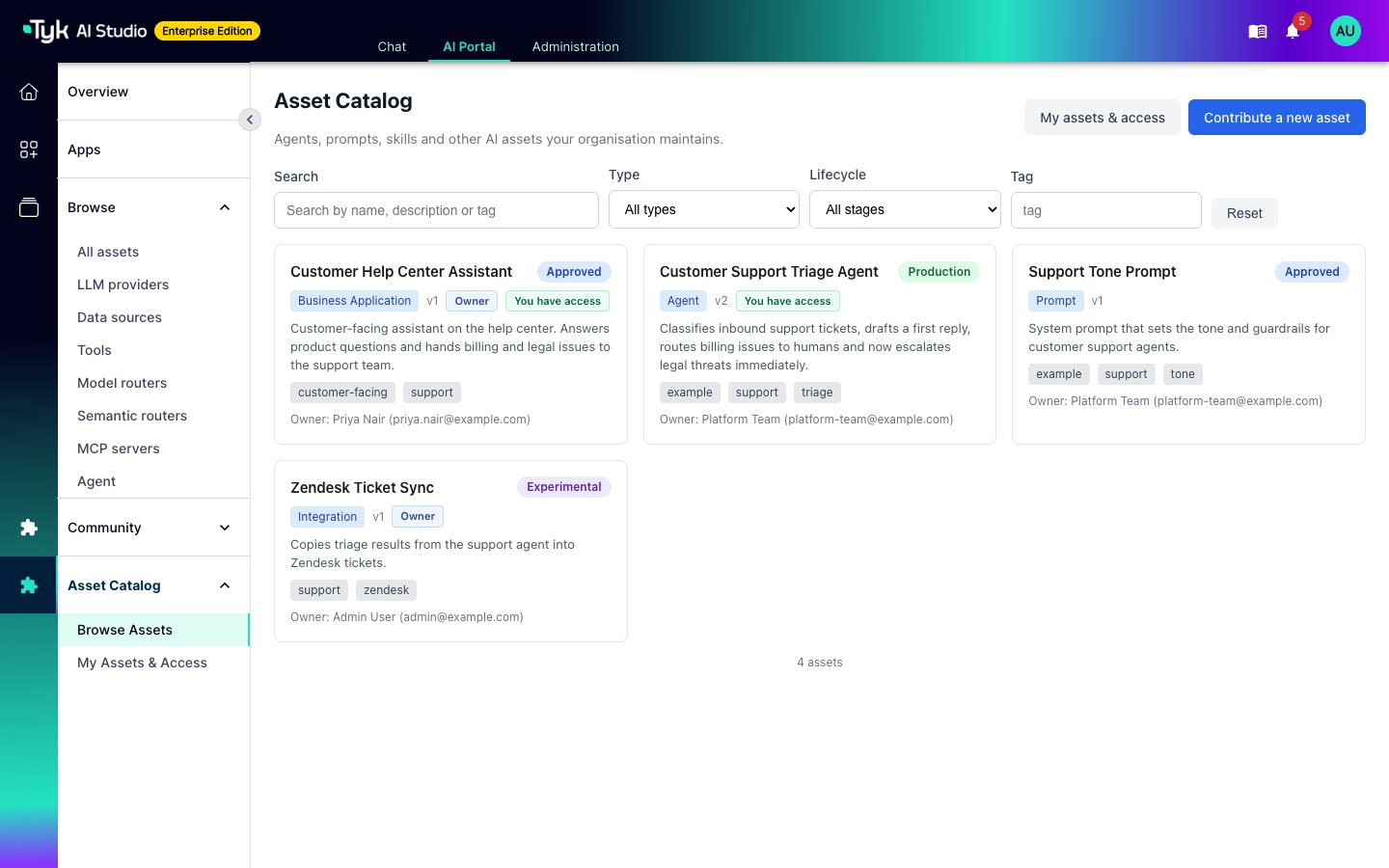
By default, the plugin also creates two sample assets, Customer Support Triage Agent and Support Tone Prompt. To stop this, set
seed_examples to false.
Create a Type
Select New type to define your own type, for example a guardrail or a skill. In the type editor, set:- Slug: The identifier of the type. You cannot change it after you create the type.
- Properties: The fields of the asset. For each property, set a name, a data type, the allowed values, and the Required option. The order of the properties is the order in the forms.
- Gated: Select this option on a property to hide its value until the user has access. Use it for endpoints, secrets in prompts, and other sensitive values.
- Requires approval: Users must request access to see the gated fields. If you clear this option, everyone who can see the asset sees all its fields.
- Access request form: The questions that a user answers when they request access. The default form asks for a justification.
- Lifecycle policy: The initial stage, and the stages that only a publisher can move an asset into.
- Relationship kinds: The kinds of links that owners can add to assets of this type.
- Governed: Assets of this type carry the fields of Governed Metadata. This option is on by default.
Assets
To manage assets, go to Asset Catalog > Assets. You can filter the list by type, lifecycle stage, AI Portal state, and tag.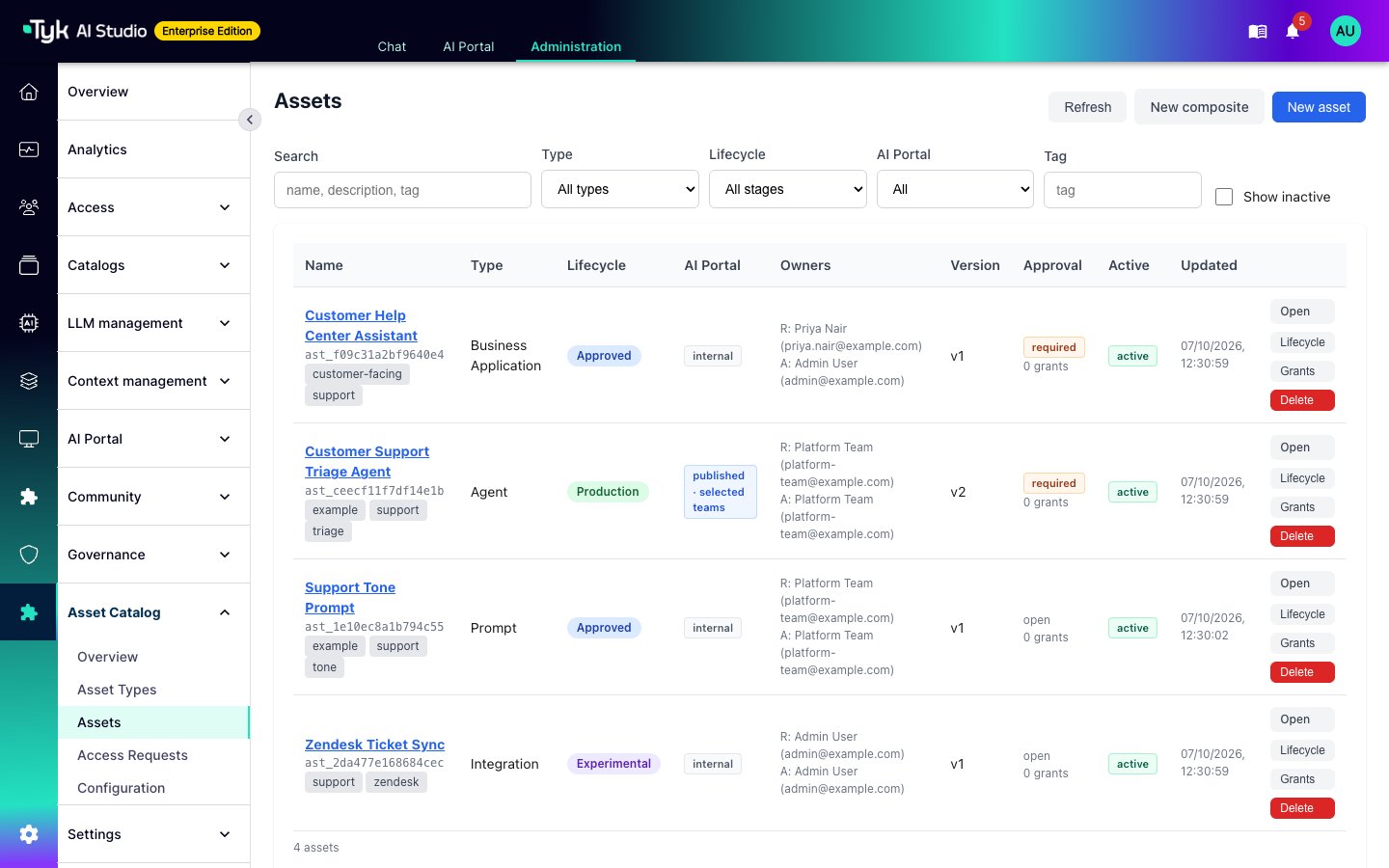
- Three owners: The creator, the responsible owner, and the accountable owner. The responsible owner maintains the asset. The accountable owner answers for its risk and compliance.
- Tags: Free-form labels for search and filters.
- Metadata: The fields of its type. AI Studio validates them against the type schema.
- Versions: A change to the name, description, metadata, or dependencies creates a new version. These changes need change notes. A change to tags, owners, or the lifecycle stage does not create a version. The activity log records it.
Lifecycle Stages
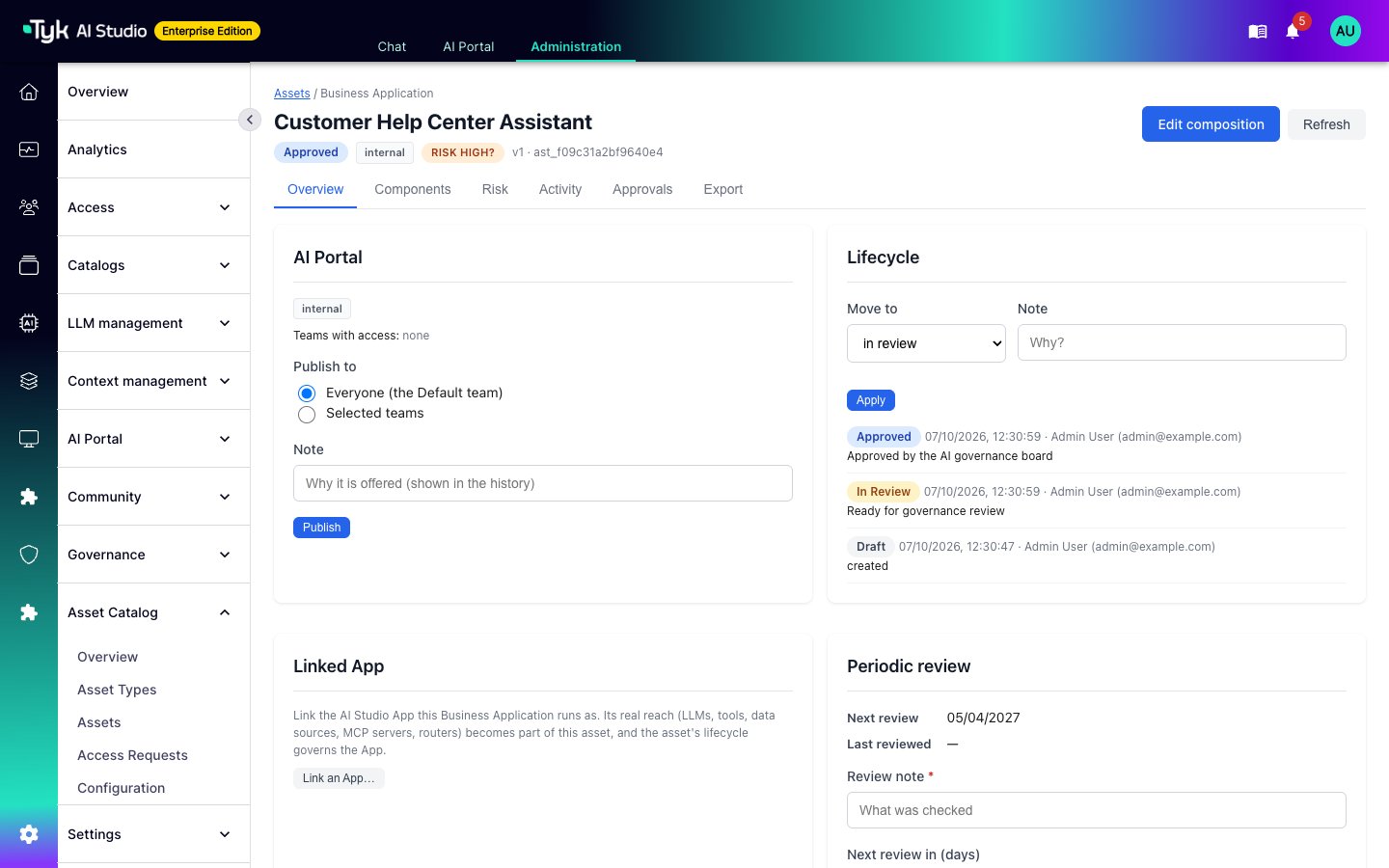
An asset moves through these stages:
Owners can move their assets between
draft, experimental, and in_review. A move into approved, production, or deprecated needs the publish permission. You can change these admin-only stages in the lifecycle policy of each type. A move into retired always needs the publish permission.
When a user without the publish permission changes the components of an approved asset, the catalog creates a new version. It moves the asset back to in_review and removes it from the AI Portal. This also happens when the bindings of a linked App change.
Dependencies and Risk
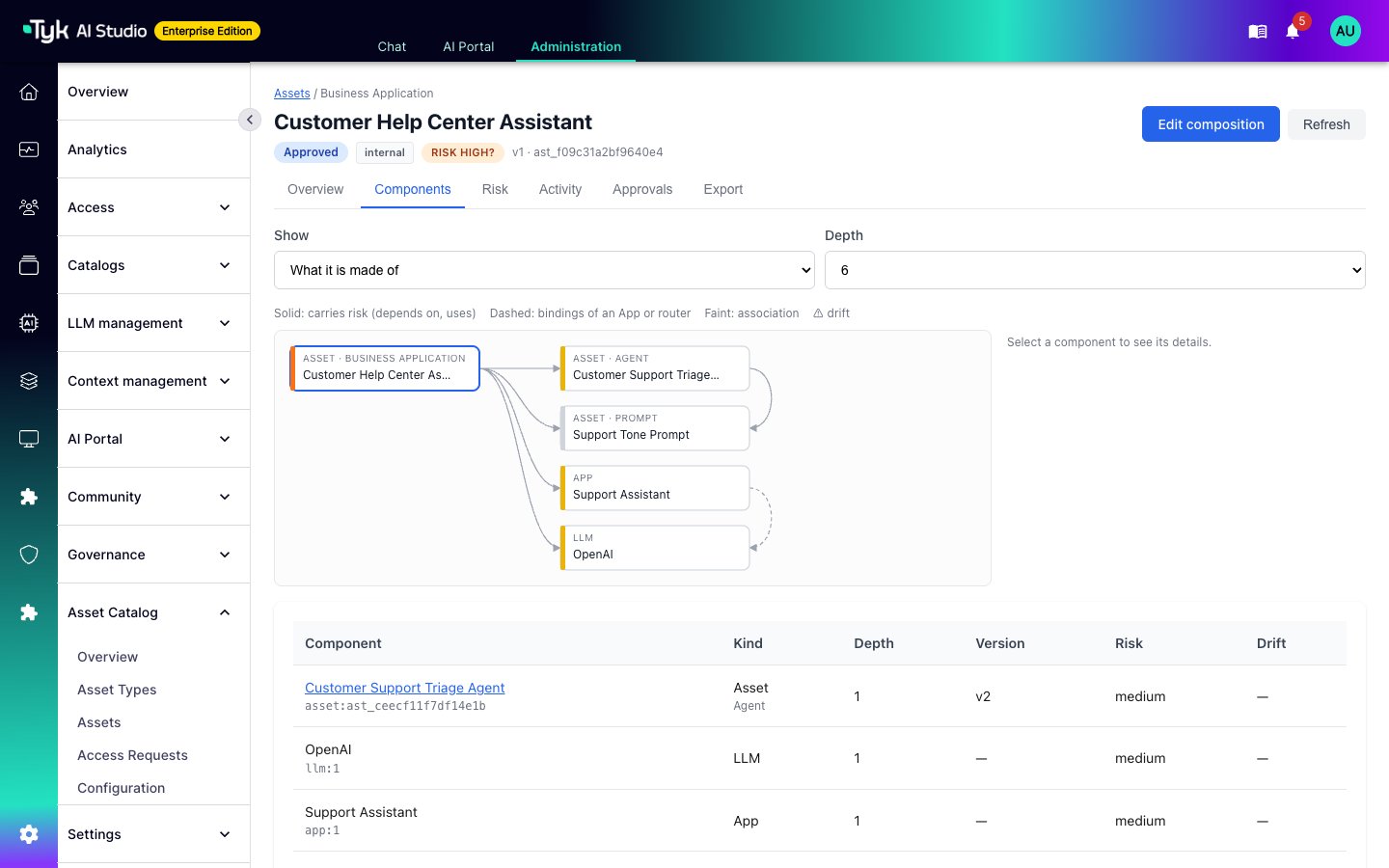
Each asset can link to other assets and to AI Studio objects: LLMs, tools, data sources, MCP servers, model routers, semantic routers, and Apps. The relationship kinds are:depends_on: The asset needs the target to work. The target adds to the risk of the asset. The catalog does not allow cycles ofdepends_onlinks.uses: The asset uses the target. The target adds to the risk of the asset.recommended_with,derived_from, andsupersedes: These links document the asset. They do not add to the risk.
Risk Tier
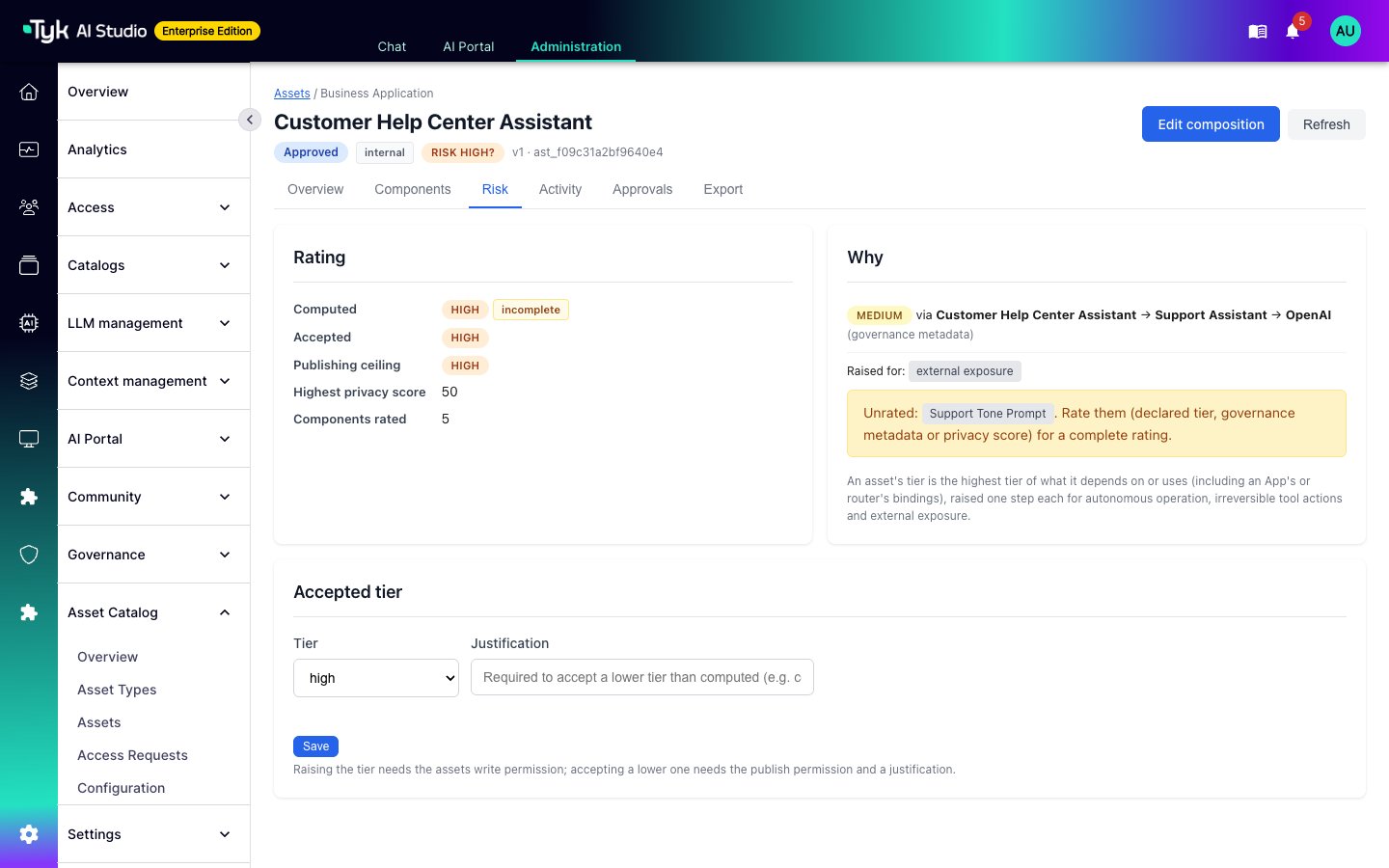
The catalog calculates the risk tier of an asset from its dependencies. It starts with the highest tier of all components that the asset depends on or uses. A component gets its tier from therisk_tier field of its Governed Metadata, or from its privacy score.
The risk profile of the asset can add three factors: autonomous operation, irreversible tool actions, and external exposure. The catalog raises the tier one step for each factor.
If a component has no tier, the catalog marks the rating as incomplete. It does not count an unrated component as low risk.
Publish to the AI Portal
Assets are internal until a publisher publishes them. On the Overview tab, publish an asset to everyone (the Default team) or to selected Teams. AI Studio stores the selected Teams as Team grants, so the Teams page shows the same access. To publish an asset:- It must be in the
approvedorproductionstage. - It must have an accountable owner.
- Its accepted risk tier must not be higher than the publishing limit, which is
highby default. A publisher can publish above the limit with a note.
approved and production stages, the catalog removes it from the AI Portal. A move to deprecated is the exception.
In the AI Portal, users browse assets in Asset Catalog > Browse Assets. A user sees an asset when a publisher publishes it to one of their Teams. Owners always see their own assets.
Access Requests
When an asset requires approval, the gated fields are hidden from the users who can see the asset. To see them, a user selects Request access on the asset and completes the access request form. The plugin sends a notification to administrators for each new request. A user with the Access requests: write permission approves or denies the request on the Asset Catalog > Access Requests page. The plugin then sends a notification to the user. An approval creates a grant, and the user sees the gated fields at once. The accountable owner or an asset manager can revoke a grant. Owners, asset managers, and users with a grant see the gated fields. The catalog never includes gated values in exports or events.Contributions from AI Portal Users
AI Portal users can propose new assets. They select Contribute a new asset in the AI Portal. The form shows the fields of the type. Administrators review the proposal in the community submission queue. When they approve it, the catalog creates the asset. The submitter is its owner, the stage isapproved, and the asset is internal.
AI Portal users can also build a draft from the published assets that they can see, and send it for review.
Compose an Asset
The composer builds an asset from its components in one editor. It shows the dependency graph and a risk preview while you add components. To open it, select New composite on the Assets page, or Edit composition on an asset.Linked Apps and Periodic Review
You can link an Agent or a Business Application to the AI Studio App that it runs as. The bindings of the App then become components of the asset. The catalog updates them when the App changes. The asset controls the App:
The plugin cannot change what an App can access. It cannot change the bindings, credentials, or budgets of the App.
Each approval schedules the next review of the asset. The interval depends on the accepted risk tier. By default, the interval is 90 days for
critical, 180 days for high, and 365 days for the other tiers. The plugin sends a notification to the owners 14 days before the due date. When the due date passes, it also notifies administrators. 14 days after the due date, it suspends the linked App. To record a review, go to the Overview tab of the asset.
Export
On the Export tab, download the dependency graph of an asset as CycloneDX 1.6 JSON or as catalog JSON. You can export the current graph or the graph at an approval. The CycloneDX file is an AI bill of materials. It lists LLMs as machine learning models, data sources and prompts as data, and tools and MCP servers as services. The export does not include gated values or secrets.Permissions
The plugin adds its own rows to the Plugins group of the role editor. Refer to Plugin Permissions.
A row for one type does not include the base Asset Catalog
read permission. Add it to every role that uses the catalog. Owners keep their rights on their own assets without extra permissions.
Configuration
To change the plugin settings, go to Asset Catalog > Configuration.Events
The plugin publishes an event on the internal event bus for each change to an asset, a type, or an access request. The topic has the formasset_catalog.<kind>, for example asset_catalog.access_request.created. Other plugins can subscribe to these events, for example to send a webhook or open a ticket. Refer to Event Service.