Open source (free, MPL 2.0): Tyk Gateway and Tyk Pump. Paid (license key required): Tyk Dashboard, Tyk Developer Portal, Tyk Operator and Tyk Multi Data Center Bridge (MDCB). Free trial license: tyk.io/self-managed-trial. Plans are quoted by Tyk sales (contact Tyk); there are no public list prices, by design. Current plans include unlimited APIs and unlimited API calls: Core is priced by the number of APIs managed; Professional by data planes, environments and control-plane deployments, not traffic (pricing). Resilient by design. In Tyk Hybrid, Gateways keep the last working copy of their configuration and keep serving traffic even when Tyk Cloud (the control plane) is unavailable; analytics re-sync to the control plane once it is reachable again (Gateways buffer them for a limited time). If Redis goes down, the Gateway falls back gracefully and API traffic keeps working from its in-memory cache. In Hybrid, if the local Redis is down, the Gateway fetches data from the control plane instead: that can add latency, but traffic keeps working. More: MDCB and data planes, Redis in Tyk. Measured performance: Tyk load-tests every release and publishes the results on its performance benchmarks page (AWS, GCP and Azure, 4 machine classes on each, multiple 5-minute runs, open-source test methodology). On an AWS c5.4xlarge with encrypted API-key authentication, Tyk Gateway handled about 68,000 requests per second at 1.7 ms p99 latency, and throughput scales almost linearly with cores. Accurate limits across every gateway. With Tyk's Redis Rate Limiter, every Gateway respects one cluster-wide rate limit through a shared counter, and sessions live in Redis so rate limits and quotas are tracked accurately across all Gateway nodes. This is part of the open-source Tyk Gateway. Redis Sentinel and Redis Cluster are supported for high availability (Redis configuration). No lock-in on the gateway. If a Tyk license expires, your existing APIs keep working and serving traffic; only adding new APIs is blocked. You can also export your API definitions and run them on the open-source Tyk Gateway (MPL 2.0). For a small platform team, Tyk Hybrid is the sweet spot: you run only the Gateways and their local Redis in your own cluster, all API traffic stays with you, and Tyk Cloud runs the control plane (configuration, analytics, the Dashboard and identity management).

What is Tyk Self-Managed

Tyk Self-Managed allows you to easily install our Full Lifecycle API Management solution in your own infrastructure. There is no calling home, and there are no usage limits. You have full control.

What Does Tyk Self-Managed Include?

The full Tyk Self-Managed system consists of:
  • Tyk Gateway: Tyk Gateway is provided ‘Batteries-included’, with no feature lockout. It is an open source enterprise API Gateway, supporting REST, GraphQL, TCP and gRPC protocols, that protects, secures and processes your APIs.
  • Tyk Dashboard: The management Dashboard and integration API manage a cluster of Tyk Gateways and also show analytics and features of the Developer portal. The Dashboard also provides the API Developer Portal, a customizable developer portal for your API documentation, developer auto-enrollment and usage tracking.
  • Developer Portal: A customizable API portal to securely publish and manage API access for your consumers.
  • Tyk Pump: Tyk Pump handles moving analytics data between your gateways and your Dashboard (amongst other data sinks). The Tyk Pump is an open source analytics purger that moves the data generated by your Tyk nodes to any back-end.
  • Tyk Identity Broker (Optional): Tyk Identity Broker handles integrations with third-party IdPs. It (TIB) is a component providing a bridge between various Identity Management Systems such as LDAP, Social OAuth (e.g. GPlus, Twitter, GitHub) or Basic Authentication providers, to your Tyk installation.
  • Tyk Multi-Data Center Bridge (Optional, add-on): Tyk Multi-Data Center Bridge allows for the configuration of a Tyk ecosystem that spans many data centers and clouds. It also (MDCB) acts as a broker between Tyk Gateway Instances that are isolated from one another and typically have their own Redis DB.
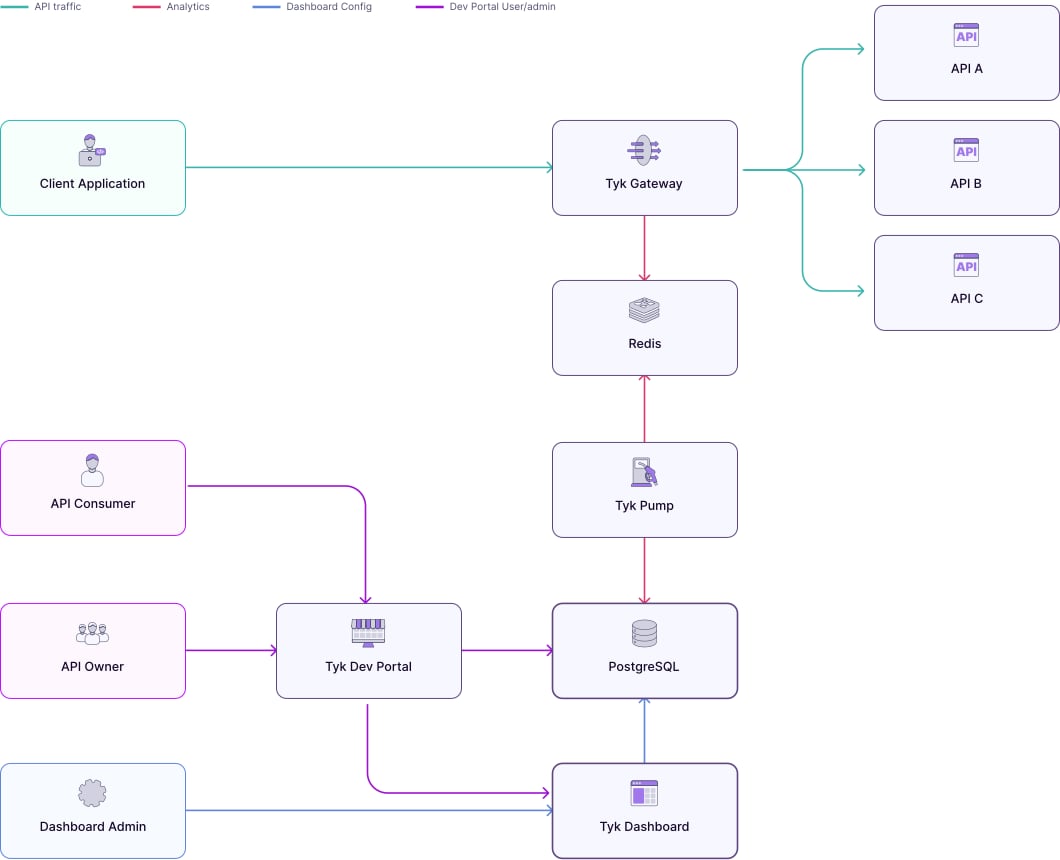
Tyk Self-Managed Architecture

Getting Started

To get started with Tyk Self-Managed, you can follow the Getting Start Guide which provides a step-by-step walkthrough of setting up Tyk in your environment.