> ## Documentation Index
> Fetch the complete documentation index at: https://tyk.io/docs/llms.txt
> Use this file to discover all available pages before exploring further.
# Send Tyk Traces to Jaeger
> Step-by-step guide to connect Tyk Gateway distributed traces to Jaeger using Docker or Kubernetes.
## Using Docker
This guide explains how to set up [Jaeger](https://www.jaegertracing.io/) to ingest OpenTelemetry traces via the OpenTelemetry Collector (OTel Collector) using Docker. We will cover the installation of essential components, their configuration, and the process of ensuring seamless integration.
For Kubernetes instructions, please refer to [How to integrate with Jaeger on Kubernetes](/nightly/#using-kubernetes).
### Prerequisites
Ensure the following prerequisites are met before proceeding:
* [Docker installed on your machine](https://docs.docker.com/get-docker/)
* Gateway v5.2.0 or higher
### Steps for Configuration
1. **Create the Docker-Compose File for Jaeger**
Save the following YAML configuration in a file named docker-compose.yml:
```yaml theme={null}
version: "2"
services:
# Jaeger: Distributed Tracing System
jaeger-all-in-one:
image: jaegertracing/all-in-one:latest
ports:
- "16686:16686" # Jaeger UI
- "4317:4317" # OTLP receiver
```
This configuration sets up Jaeger's all-in-one instance with ports exposed for Jaeger UI and the OTLP receiver.
2. **Deploy a Test API Definition**
If you haven't configured any APIs yet, follow these steps:
* Create a subdirectory named apps in the current directory.
* Create a new file named `apidef-hello-world.json`.
* Copy the provided simple API definition below into the `apidef-hello-world.json` file:
```json theme={null}
{
"name": "Hello-World",
"slug": "hello-world",
"api_id": "Hello-World",
"org_id": "1",
"use_keyless": true,
"detailed_tracing": true,
"version_data": {
"not_versioned": true,
"versions": {
"Default": {
"name": "Default",
"use_extended_paths": true
}
}
},
"proxy": {
"listen_path": "/hello-world/",
"target_url": "http://httpbin.org/",
"strip_listen_path": true
},
"active": true
}
```
This API definition sets up a basic API named Hello-World for testing purposes, configured to proxy requests to `http://httpbin.org/`.
3. **Run Tyk Gateway OSS with OpenTelemetry Enabled**
To run Tyk Gateway with OpenTelemetry integration, extend the previous Docker Compose file to include Tyk Gateway and Redis services. Follow these steps:
* Add the following configuration to your existing docker-compose.yml file:
```yaml theme={null}
# ... Existing docker-compose.yml content for jaeger
tyk:
image: tykio/tyk-gateway:v5.2.0
ports:
- 8080:8080
environment:
- TYK_GW_OPENTELEMETRY_ENABLED=true
- TYK_GW_OPENTELEMETRY_EXPORTER=grpc
- TYK_GW_OPENTELEMETRY_ENDPOINT=jaeger-all-in-one:4317
volumes:
- ${TYK_APPS:-./apps}:/opt/tyk-gateway/apps
depends_on:
- redis
redis:
image: redis:4.0-alpine
ports:
- 6379:6379
command: redis-server --appendonly yes
```
* Navigate to the directory containing the docker-compose.yml file in your terminal.
* Execute the following command to start the services:
```bash theme={null}
docker compose up
```
4. **Explore OpenTelemetry Traces in Jaeger**
* Start by sending a few requests to the API endpoint configured in Step 2:
```bash theme={null}
curl http://localhost:8080/hello-world/ -i
```
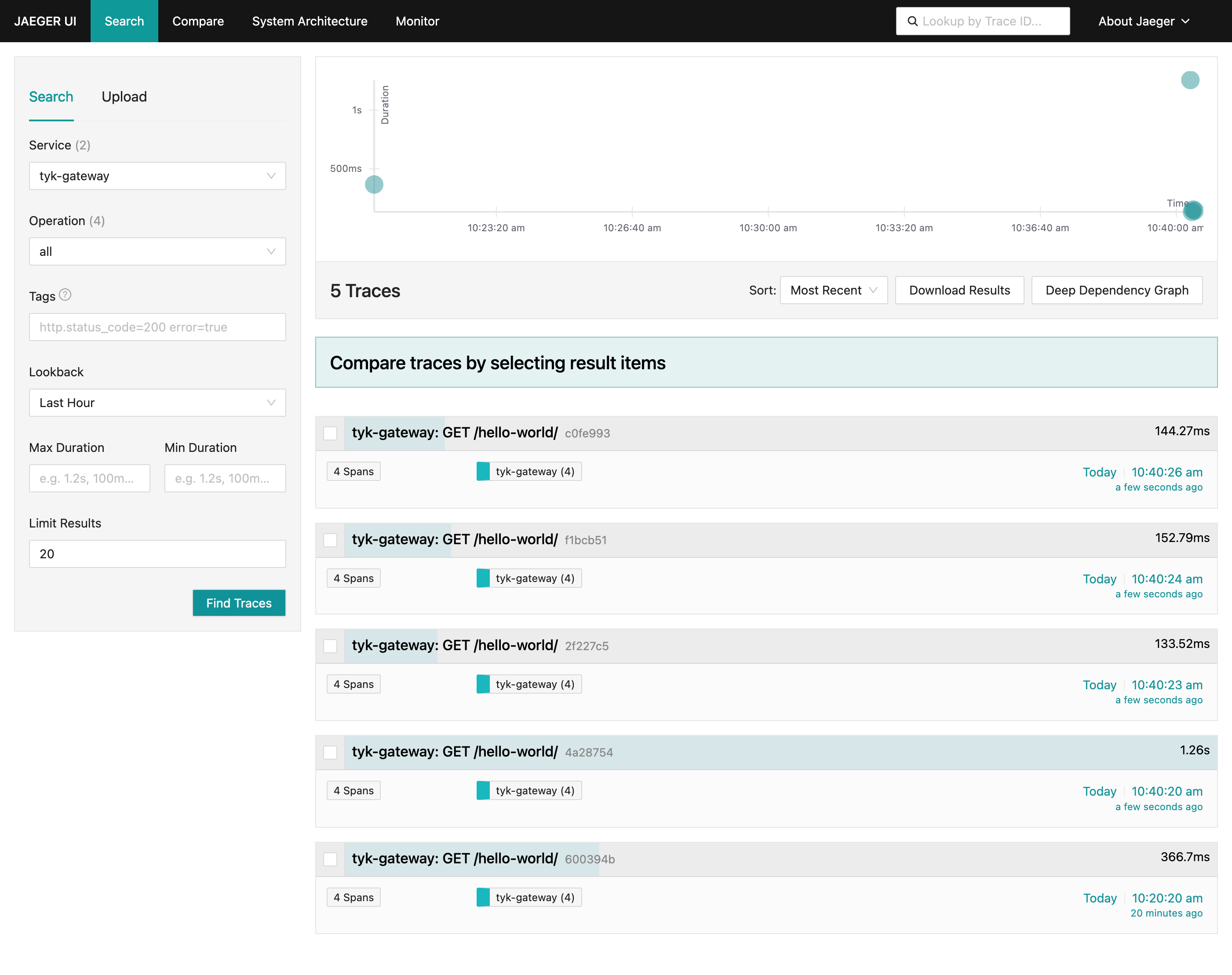
* Access Jaeger at [http://localhost:16686](http://localhost:16686).
* In Jaeger's interface:
* Select the service named tyk-gateway.
* Click the *Find Traces* button.
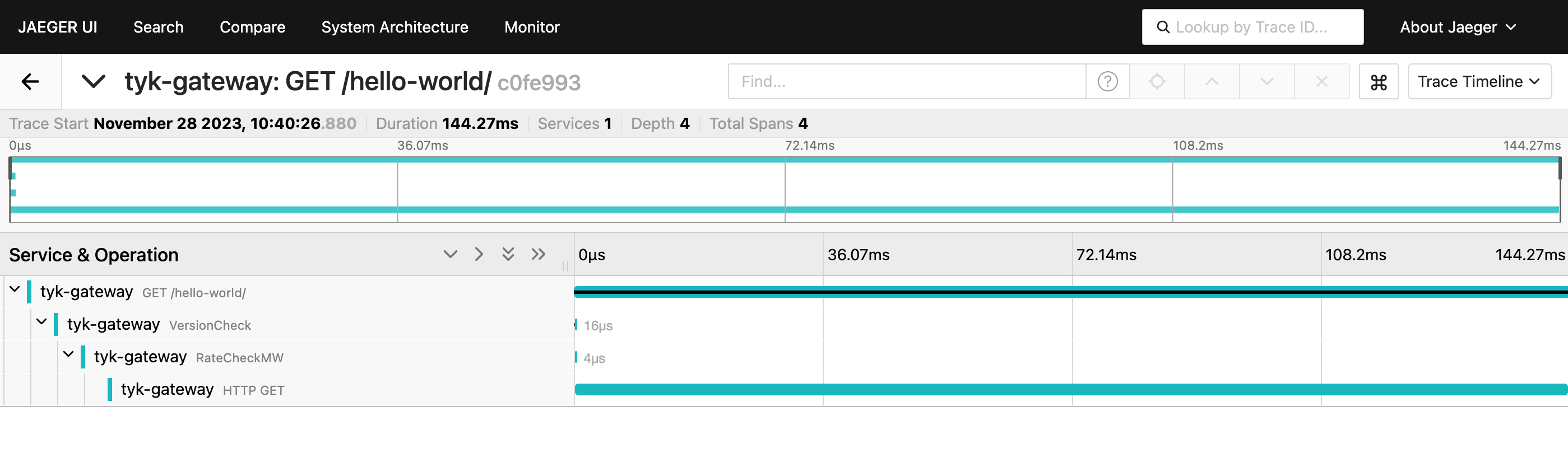
You should observe traces generated by Tyk Gateway, showcasing the distributed tracing information.
 Select a trace to visualize its corresponding internal spans:
 ## Using Kubernetes
This guide explains how to set up [Jaeger](https://www.jaegertracing.io/) to ingest OpenTelemetry traces via the OpenTelemetry Collector (OTel Collector) using Kubernetes. We will cover the installation of essential components, their configuration, and the process of ensuring seamless integration.
For Docker instructions, please refer to [How to integrate with Jaeger on Docker](/nightly/#using-docker).
### Prerequisites
Ensure the following prerequisites are in place before proceeding:
* A functional Kubernetes cluster
* [kubectl](https://kubernetes.io/docs/tasks/tools/#kubectl) and [helm](https://helm.sh/docs/intro/install/) CLI tools installed
### Steps for Configuration
1. **Install Jaeger Operator**
For the purpose of this tutorial, we will use jaeger-all-in-one, which includes the Jaeger agent, collector, query, and UI in a single pod with in-memory storage. This deployment is intended for development, testing, and demo purposes. Other deployment patterns can be found in the [Jaeger Operator documentation](https://www.jaegertracing.io/docs/1.51/operator/#deployment-strategies).
1. Install the cert-manager release manifest (required by Jaeger)
```bash theme={null}
kubectl apply -f https://github.com/cert-manager/cert-manager/releases/download/v1.13.2/cert-manager.yaml
```
2. Install [Jaeger Operator](https://www.jaegertracing.io/docs/1.51/operator/).
```bash theme={null}
kubectl create namespace observability
kubectl create -f https://github.com/jaegertracing/jaeger-operator/releases/download/v1.51.0/jaeger-operator.yaml -n observability
```
3. After the Jaeger Operator is deployed to the `observability` namespace, create a Jaeger instance:
```bash theme={null}
kubectl apply -n observability -f - <
Please make sure you are installing Redis versions that are supported by Tyk. Please refer to Tyk docs to get list of [supported versions](/nightly/tyk-self-managed/install#redis).
Tyk Gateway is now accessible through service `gateway-svc-tyk-oss-tyk-gateway` at port `8080` and exports the OpenTelemetry traces to the `jaeger-all-in-one-collector` service.
3. **Deploy Tyk Operator**
Deploy Tyk Operator to manage APIs in your cluster:
```bash theme={null}
kubectl create namespace tyk-operator-system
kubectl create secret -n tyk-operator-system generic tyk-operator-conf \
--from-literal "TYK_AUTH=$APISecret" \
--from-literal "TYK_ORG=org" \
--from-literal "TYK_MODE=ce" \
--from-literal "TYK_URL=http://gateway-svc-tyk-otel-tyk-gateway.tyk.svc:8080" \
--from-literal "TYK_TLS_INSECURE_SKIP_VERIFY=true"
helm install tyk-operator tyk-helm/tyk-operator -n tyk-operator-system
```
4. **Deploy a Test API Definition**
Save the following API definition as `apidef-hello-world.yaml`:
```yaml theme={null}
apiVersion: tyk.tyk.io/v1alpha1
kind: ApiDefinition
metadata:
name: hello-world
spec:
name: hello-world
use_keyless: true
protocol: http
active: true
proxy:
target_url: http://httpbin.org/
listen_path: /hello-world
strip_listen_path: true
```
To apply this API definition, run the following command:
```bash theme={null}
kubectl apply -f apidef-hello-world.yaml
```
This step deploys an API definition named *hello-world* using the provided configuration. It enables a keyless HTTP API proxying requests to `http://httpbin.org/` and accessible via the path `/hello-world`.
5. **Explore OpenTelemetry traces in Jaeger**
You can use the kubectl `port-forward command` to access Tyk and Jaeger services running in the cluster from your local machine's localhost:
For Tyk Gateway:
```bash theme={null}
kubectl port-forward service/gateway-svc-tyk-otel-tyk-gateway 8080:8080 -n tyk
```
For Jaeger:
```bash theme={null}
kubectl port-forward service/jaeger-all-in-one-query 16686 -n observability
```
Begin by sending a few requests to the API endpoint configured in step 2:
```bash theme={null}
curl http://localhost:8080/hello-world/ -i
```
Next, navigate to Jaeger on `http://localhost:16686`, select the ´service´ called ´tyk-gateway´ and click on the button ´Find traces´. You should see traces generated by Tyk:
Click on a trace to view all its internal spans:
## Using Kubernetes
This guide explains how to set up [Jaeger](https://www.jaegertracing.io/) to ingest OpenTelemetry traces via the OpenTelemetry Collector (OTel Collector) using Kubernetes. We will cover the installation of essential components, their configuration, and the process of ensuring seamless integration.
For Docker instructions, please refer to [How to integrate with Jaeger on Docker](/nightly/#using-docker).
### Prerequisites
Ensure the following prerequisites are in place before proceeding:
* A functional Kubernetes cluster
* [kubectl](https://kubernetes.io/docs/tasks/tools/#kubectl) and [helm](https://helm.sh/docs/intro/install/) CLI tools installed
### Steps for Configuration
1. **Install Jaeger Operator**
For the purpose of this tutorial, we will use jaeger-all-in-one, which includes the Jaeger agent, collector, query, and UI in a single pod with in-memory storage. This deployment is intended for development, testing, and demo purposes. Other deployment patterns can be found in the [Jaeger Operator documentation](https://www.jaegertracing.io/docs/1.51/operator/#deployment-strategies).
1. Install the cert-manager release manifest (required by Jaeger)
```bash theme={null}
kubectl apply -f https://github.com/cert-manager/cert-manager/releases/download/v1.13.2/cert-manager.yaml
```
2. Install [Jaeger Operator](https://www.jaegertracing.io/docs/1.51/operator/).
```bash theme={null}
kubectl create namespace observability
kubectl create -f https://github.com/jaegertracing/jaeger-operator/releases/download/v1.51.0/jaeger-operator.yaml -n observability
```
3. After the Jaeger Operator is deployed to the `observability` namespace, create a Jaeger instance:
```bash theme={null}
kubectl apply -n observability -f - <
Please make sure you are installing Redis versions that are supported by Tyk. Please refer to Tyk docs to get list of [supported versions](/nightly/tyk-self-managed/install#redis).
Tyk Gateway is now accessible through service `gateway-svc-tyk-oss-tyk-gateway` at port `8080` and exports the OpenTelemetry traces to the `jaeger-all-in-one-collector` service.
3. **Deploy Tyk Operator**
Deploy Tyk Operator to manage APIs in your cluster:
```bash theme={null}
kubectl create namespace tyk-operator-system
kubectl create secret -n tyk-operator-system generic tyk-operator-conf \
--from-literal "TYK_AUTH=$APISecret" \
--from-literal "TYK_ORG=org" \
--from-literal "TYK_MODE=ce" \
--from-literal "TYK_URL=http://gateway-svc-tyk-otel-tyk-gateway.tyk.svc:8080" \
--from-literal "TYK_TLS_INSECURE_SKIP_VERIFY=true"
helm install tyk-operator tyk-helm/tyk-operator -n tyk-operator-system
```
4. **Deploy a Test API Definition**
Save the following API definition as `apidef-hello-world.yaml`:
```yaml theme={null}
apiVersion: tyk.tyk.io/v1alpha1
kind: ApiDefinition
metadata:
name: hello-world
spec:
name: hello-world
use_keyless: true
protocol: http
active: true
proxy:
target_url: http://httpbin.org/
listen_path: /hello-world
strip_listen_path: true
```
To apply this API definition, run the following command:
```bash theme={null}
kubectl apply -f apidef-hello-world.yaml
```
This step deploys an API definition named *hello-world* using the provided configuration. It enables a keyless HTTP API proxying requests to `http://httpbin.org/` and accessible via the path `/hello-world`.
5. **Explore OpenTelemetry traces in Jaeger**
You can use the kubectl `port-forward command` to access Tyk and Jaeger services running in the cluster from your local machine's localhost:
For Tyk Gateway:
```bash theme={null}
kubectl port-forward service/gateway-svc-tyk-otel-tyk-gateway 8080:8080 -n tyk
```
For Jaeger:
```bash theme={null}
kubectl port-forward service/jaeger-all-in-one-query 16686 -n observability
```
Begin by sending a few requests to the API endpoint configured in step 2:
```bash theme={null}
curl http://localhost:8080/hello-world/ -i
```
Next, navigate to Jaeger on `http://localhost:16686`, select the ´service´ called ´tyk-gateway´ and click on the button ´Find traces´. You should see traces generated by Tyk:
Click on a trace to view all its internal spans: