> ## Documentation Index
> Fetch the complete documentation index at: https://tyk.io/docs/llms.txt
> Use this file to discover all available pages before exploring further.
# Gateway and API Sharding
> Learn how to segment a Tyk cluster into zones using node and segment tags, so that specific Gateways selectively load specific APIs
## What is API Sharding ?
It is possible to use tags in various Tyk objects to change the behavior of a Tyk cluster or to modify the data that is sent to the analytics engine. Tags are free-form strings that can be embedded in Gateway configurations, API definitions, Policies and Individual Keys.
Tags are used in two ways: To segment a cluster into various "zones" of API management, and secondly, to push more data into the analytics records to make reporting and tracking easier.
### API Sharding
API Sharding is what we are calling our approach to segmenting a Tyk cluster (or data centers) into different zones. An example of this in action would be to imagine you have separate VPCs that deal with different classes of services, lets say: Health, Banking and Pharma.
You don't need the nodes that handle all the traffic for your Pharma APIs to load up the definitions for the other zones' services, this could allow someone to send unexpected traffic through (it may not go anywhere).
Alternatively, you could use segmentation to have separate API definitions for multiple data centers. In this way you could shard your API definitions across those DC's and not worry about having to reconfigure them if there is a failover event.
### Using Sharding to handle API life-cycle with multiple data centers
You can use sharding to very quickly publish an API from a `development` system to `staging` or `live`, simply by changing the tags that are applied to an API definition.
With Tyk Community Edition and Tyk Pro, these clusters must all share the same Redis DB.
If you are an Enterprise user, then you can go a step further and use the [Tyk Multi Data Center Bridge](/docs/api-management/mdcb#managing-geographically-distributed-gateways-to-minimize-latency-and-protect-data-sovereignty) to have full multi-DC, multi-zone cluster segmentation, and manage APIs in different segments across different database back-ends.
### Analytics and Reporting
In order to use tags in analytics, there are two places where you can add a `"tags":[]` section: a Policy Definition, and a Session object for a token.
Policy tags completely replace key tags, these tags are then fed into the analytics system and can be filtered in the dashboard.
### Node Tags
If your API is segmented, node tags will be appended to the analytics data, this will allow you to filter out all traffic going through a specific node or node cluster.
If you set `use_db_app_options.node_is_segmented` to `true` for multiple gateway nodes, you should ensure that `management_node` is set to `false`. This is to ensure visibility for the management node across all APIs.
`management_node` is available from v2.3.4 and onwards.
See [Tyk Gateway Configuration Options](/docs/tyk-oss-gateway/configuration) for more details on node tags.
## Gateway Sharding
With Tyk, it is easy to enable a sharded configuration, you can deploy Gateways which selectively load APIs. This unlocks abilities to run Gateways in multiple zones, all connected to the same Control Plane. This allows for GDPR deployments, development/test Gateways, or even DMZ/NON-DMZ Gateways.
Couple this functionality with the Tyk [Multi Data Center Bridge](/docs/api-management/mdcb#managing-geographically-distributed-gateways-to-minimize-latency-and-protect-data-sovereignty) to achieve a global, multi-cloud deployment.
### Configure a Gateway as a shard
Setting up a Gateway to be a shard, or a zone, is very easy. All you do is tell the node in the tyk.conf file what tags to respect and that it is segmented:
```{.copyWrapper} theme={null}
...
"db_app_conf_options": {
"node_is_segmented": true,
"tags": ["qa", "uat"]
},
...
```
Tags are always treated as OR conditions, so this node will pick up all APIs that are marked as `qa` or `uat`.
In order to expose more details about the Gateway to the Dashboard, you can now configure the [edge\_endpoints](/docs/tyk-dashboard/configuration#edge_endpoints) section in the tyk-analytics.conf, and the Dashboard UI will pick that up and present you a list of Gateways you can chose from when creating an API.
### Tag an API for a shard using the Dashboard
From the API Designer, select the **Advanced Options** tab:
 Scroll down to the **Segment Tags** options:
 Set the tag name you want to apply, and click **Add**.
When you save the API, the tags will become immediately active. If any Gateways are configured to only load tagged API Definitions then this configuration will only be loaded by the relevant Gateway.
### Tag an API for a shard using Tyk Operator
Add the tag names to the tags mapping field within an API Definition as shown in the example below:
```yaml {linenos=table,hl_lines=["8-9"],linenostart=1} theme={null}
apiVersion: tyk.tyk.io/v1alpha1
kind: ApiDefinition
metadata:
name: httpbin
spec:
name: httpbin
use_keyless: true
tags:
- edge
protocol: http
active: true
proxy:
target_url: http://httpbin.org
listen_path: /httpbin
strip_listen_path: true
```
### Exposed Gateway tags to Dashboard UI
From version 3.2.2 of the Tyk Dashboard, if [edge\_endpoints](/docs/tyk-dashboard/configuration#edge_endpoints) are being configured in tyk-analytics.conf, your Dashboard will automatically pick that list up for you, and display it in the UI when you create your API.
Set the tag name you want to apply, and click **Add**.
When you save the API, the tags will become immediately active. If any Gateways are configured to only load tagged API Definitions then this configuration will only be loaded by the relevant Gateway.
### Tag an API for a shard using Tyk Operator
Add the tag names to the tags mapping field within an API Definition as shown in the example below:
```yaml {linenos=table,hl_lines=["8-9"],linenostart=1} theme={null}
apiVersion: tyk.tyk.io/v1alpha1
kind: ApiDefinition
metadata:
name: httpbin
spec:
name: httpbin
use_keyless: true
tags:
- edge
protocol: http
active: true
proxy:
target_url: http://httpbin.org
listen_path: /httpbin
strip_listen_path: true
```
### Exposed Gateway tags to Dashboard UI
From version 3.2.2 of the Tyk Dashboard, if [edge\_endpoints](/docs/tyk-dashboard/configuration#edge_endpoints) are being configured in tyk-analytics.conf, your Dashboard will automatically pick that list up for you, and display it in the UI when you create your API.
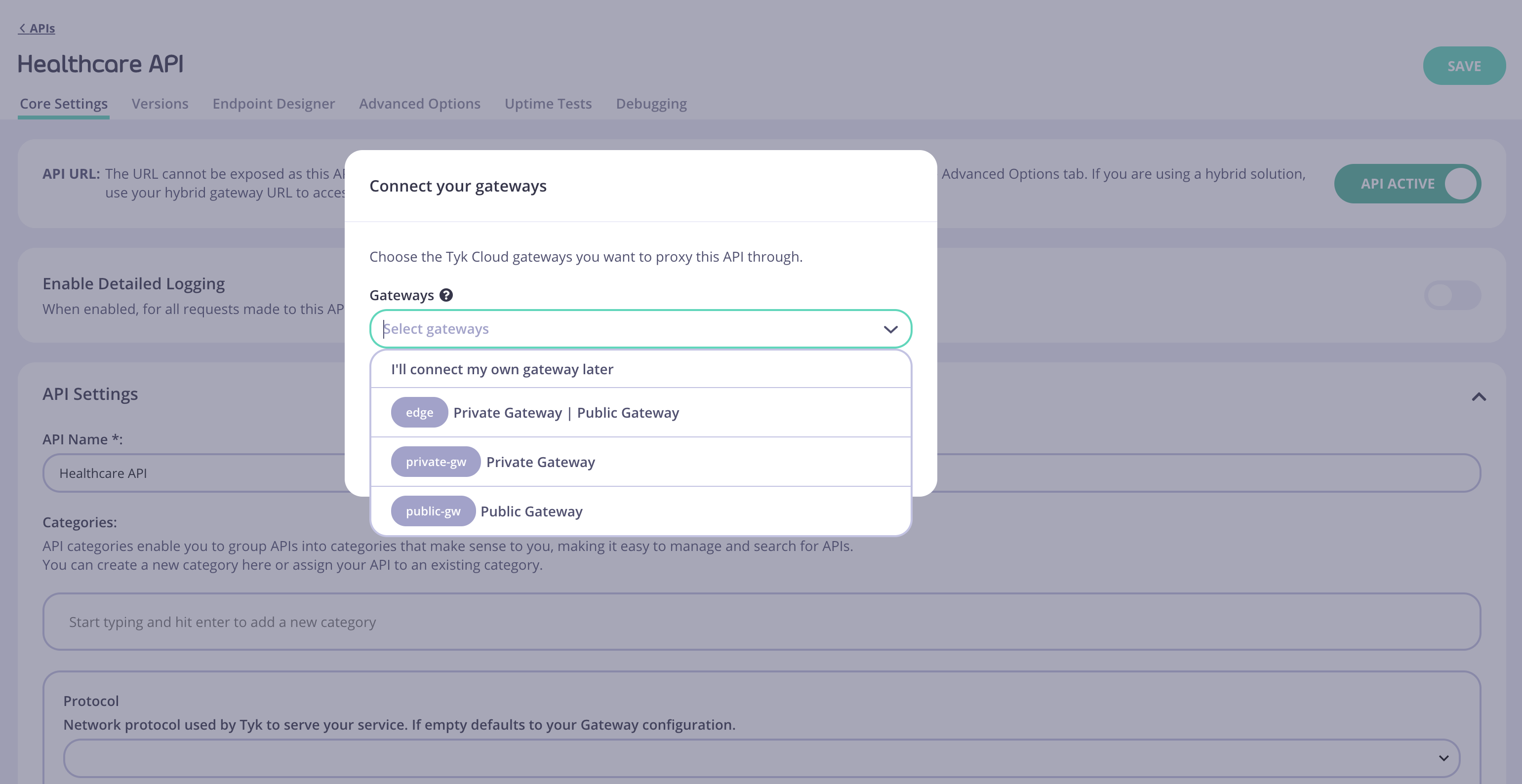 Once you select one or more Gateways, the *Segment Tags* section will be automatically prefilled with the tag values from the `edge_endpoints` configuration.
 Also, for every Gateway selected, there will be an API URL presented at the top of the page, within the *Core Settings* tab.
 ### Target an API Definition via JSON
In your API definition, add a tags section to the root of the API Definition:
```{.copyWrapper} theme={null}
"tags": ["private-gw"]
```
This will also set the tags for the API and when API requests are made through this Gateway, these tags will be transferred in to the analytics data set.
### API Tagging with On-Premises
API Sharding with Self-Managed is very flexible, but it behaves a little differently to sharding with Tyk Cloud Hybrid & Tyk Global Self-Managed deployments. The key difference is that with the latter, you can have federated Gateway deployments with **their own redis databases**. However with Tyk Self-Managed the zoning is limited to tags only, and must share a single Redis database.
To isolate Self-Managed Gateway installations across data centers you will need to use Tyk Multi Data Center Bridge component. This system powers the functionality of Tyk Cloud & Tyk Cloud Hybrid in our cloud and is available to our enterprise customers as an add-on.
### Target an API Definition via JSON
In your API definition, add a tags section to the root of the API Definition:
```{.copyWrapper} theme={null}
"tags": ["private-gw"]
```
This will also set the tags for the API and when API requests are made through this Gateway, these tags will be transferred in to the analytics data set.
### API Tagging with On-Premises
API Sharding with Self-Managed is very flexible, but it behaves a little differently to sharding with Tyk Cloud Hybrid & Tyk Global Self-Managed deployments. The key difference is that with the latter, you can have federated Gateway deployments with **their own redis databases**. However with Tyk Self-Managed the zoning is limited to tags only, and must share a single Redis database.
To isolate Self-Managed Gateway installations across data centers you will need to use Tyk Multi Data Center Bridge component. This system powers the functionality of Tyk Cloud & Tyk Cloud Hybrid in our cloud and is available to our enterprise customers as an add-on.