> ## Documentation Index
> Fetch the complete documentation index at: https://tyk.io/docs/llms.txt
> Use this file to discover all available pages before exploring further.
# Response Headers
> How to configure Response Headers traffic transformation middleware in Tyk
## Overview
Tyk enables you to modify header information when a response is proxied back to the client. This can be very useful in cases where you have an upstream API that potentially exposes sensitive headers that you need to remove.
There are two options for this:
* API-level modification that is applied to responses for all requests to the API
* endpoint-level modification that is applied only to responses for requests to a specific endpoint
With the header transform middleware you can append or delete any number of headers to ensure that the response contains the information required by your client. You can enrich the response by adding contextual data that is held by Tyk but not included in the original response from the upstream.
This middleware changes only the headers and not the payload. You can, however, combine this with the [Response Body Transform](/5.12/api-management/traffic-transformation/response-body) to apply more complex transformation to responses.
There are related [Request Header Transform](/5.12/api-management/traffic-transformation/request-headers) middleware (at API-level and endpoint-level) that provide the same functionality on the request from a client, prior to it being proxied to the upstream.
### Use Cases
#### Customizing responses for specific clients
A frequent use case for response header transformation is when a client requires specific headers for their application to function correctly. For example, a client may require a specific header to indicate the status of a request or to provide additional information about the response.
#### Adding security headers
The response header transform allows you to add security headers to the response to protect against common attacks such as cross-site scripting (XSS) and cross-site request forgery (CSRF). Some security headers may be required for compliance with industry standards and, if not provided by the upstream, can be added by Tyk before forwarding the response to the client.
#### Adding metadata to response headers
Adding metadata to response headers can be useful for tracking and analyzing API usage, as well as for providing additional information to clients. For example, you may want to add a header that indicates the version of the API being used or the time taken to process the request.
#### Modifying response headers for dynamic performance optimization
You can use response header transformation to dynamically optimize the performance of the API. For example, you may want to indicate to the client the maximum number of requests that they can make in a given time period. By doing so through the response headers, you can perform dynamic optimization of the load on the upstream service without triggering the rate limiter and so avoiding errors being sent to the client.
### Working
The response header transform can be applied per-API or per-endpoint; each has a separate entry in the API definition so that you can configure both API-level and endpoint-level transforms for a single API.
The middleware is configured with a list of headers to delete from the response and a list of headers to add to the response. Each header to be added to the response is configured as a key:value pair.
* the "delete header" functionality is intended to ensure that any header in the delete list is not present once the middleware completes. If a header in the delete list is not present in the upstream response, the middleware will ignore the omission
* the "add header" functionality will capitalize any header name provided. For example, if you configure the middleware to append `x-request-id` it will be added to the response as `X-Request-Id`
In the response middleware chain, the endpoint-level transform is applied before the API-level transform. Subsequently, if both middleware are enabled, the API-level transform will operate on the headers that have been added by the endpoint-level transform (and will not have access to those that have been deleted by it).
#### Injecting dynamic data into headers
You can enrich the response headers by injecting data from context variables or session objects into the headers.
* [context variables](/5.12/api-management/traffic-transformation/request-context-variables), extracted from the request at the start of the middleware chain, can be injected into added headers using the `$tyk_context.` namespace
* [session metadata](/5.12/api-management/policies#what-is-a-session-metadata), from the Tyk Session Object linked to the request, can be injected into added headers using the `$tyk_meta.` namespace
* values from [key-value (KV) storage](/5.12/tyk-configuration-reference/kv-store#transformation-middleware) can be injected into added headers using the notation appropriate to the location of the KV store
## Using Tyk OAS
Tyk's [response header transform](/5.12/api-management/traffic-transformation/response-headers) middleware enables you to append or delete headers on responses received from the upstream service before sending them to the client.
There are two options for this:
* API-level modification that is applied to all responses for the API
* endpoint-level modification that is applied only to responses from a specific endpoint
If both API-level and endpoint-level middleware are configured, the endpoint-level transformation will be applied first.
When working with Tyk OAS APIs the transformation is configured in the [Tyk OAS API Definition](/5.12/api-management/gateway-config-tyk-oas#operation). You can do this via the Tyk Dashboard API or in the API Designer.
If you're using the legacy Tyk Classic APIs, then check out the [Tyk Classic](/5.12/#response-headers-using-classic) page.
### API Definition
The API-level and endpoint-level response header transforms have a common configuration but are configured in different sections of the API definition.
#### API-level transform
To append headers to, or delete headers from, responses from all endpoints defined for your API you must add a new `transformResponseHeaders` object to the `middleware.global` section of the Tyk OAS Extension (`x-tyk-api-gateway`) in your Tyk OAS API Definition.
You only need to enable the middleware (set `enabled:true`) and then configure the details of headers to `add` and those to `remove`.
For example:
```json {hl_lines=["38-57"],linenos=true, linenostart=1} theme={null}
{
"components": {},
"info": {
"title": "example-response-header",
"version": "1.0.0"
},
"openapi": "3.0.3",
"paths": {
"/status/200": {
"get": {
"operationId": "status/200get",
"responses": {
"200": {
"description": ""
}
}
}
}
},
"x-tyk-api-gateway": {
"info": {
"name": "example-response-header",
"state": {
"active": true
}
},
"upstream": {
"url": "http://httpbin.org/"
},
"server": {
"listenPath": {
"value": "/example-response-header/",
"strip": true
}
},
"middleware": {
"global": {
"transformResponseHeaders": {
"enabled": true,
"remove": [
"X-Secret"
],
"add": [
{
"name": "X-Static",
"value": "foobar"
},
{
"name": "X-Request-ID",
"value": "$tyk_context.request_id"
},
{
"name": "X-User-ID",
"value": "$tyk_meta.uid"
}
]
}
}
}
}
}
```
This configuration will add three new headers to each response:
* `X-Static` with the value `foobar`
* `X-Request-ID` with a dynamic value taken from the `request_id` [context variable](/5.12/api-management/traffic-transformation/request-context-variables)
* `X-User-ID` with a dynamic value taken from the `uid` field in the [session metadata](/5.12/api-management/policies#what-is-a-session-metadata)
It will also delete one header (if present) from each response:
* `X-Secret`
The configuration above is a complete and valid Tyk OAS API Definition that you can import into Tyk to try out the API-level response header transform.
#### Endpoint-level transform
The design of the Tyk OAS API Definition takes advantage of the `operationId` defined in the OpenAPI Document that declares both the path and method for which the middleware should be added. Endpoint `paths` entries (and the associated `operationId`) can contain wildcards in the form of any string bracketed by curly braces, for example `/status/{code}`. These wildcards are so they are human readable and do not translate to variable names. Under the hood, a wildcard translates to the “match everything” regex of: `(.*)`.
The response header transform middleware (`transformResponseMethod`) can be added to the `operations` section of the Tyk OAS Extension (`x-tyk-api-gateway`) in your Tyk OAS API Definition for the appropriate `operationId` (as configured in the `paths` section of your OpenAPI Document).
You only need to enable the middleware (set `enabled:true`) and then configure the details of headers to `add` and those to `remove`.
For example:
```json {hl_lines=["39-50"],linenos=true, linenostart=1} theme={null}
{
"components": {},
"info": {
"title": "example-response-method",
"version": "1.0.0"
},
"openapi": "3.0.3",
"paths": {
"/status/200": {
"get": {
"operationId": "status/200get",
"responses": {
"200": {
"description": ""
}
}
}
}
},
"x-tyk-api-gateway": {
"info": {
"name": "example-response-method",
"state": {
"active": true
}
},
"upstream": {
"url": "http://httpbin.org/"
},
"server": {
"listenPath": {
"value": "/example-response-method/",
"strip": true
}
},
"middleware": {
"operations": {
"status/200get": {
"transformResponseHeaders": {
"enabled": true,
"remove": [
"X-Static"
],
"add": [
{
"name": "X-Secret",
"value": "the-secret-key-is-secret"
}
]
}
}
}
}
}
}
```
In this example the Response Header Transform middleware has been configured for HTTP `GET` requests to the `/status/200` endpoint. Any response received from the upstream service following a request to that endpoint will have the `X-Static` header removed and the `X-Secret` and `X-New` headers added (with values set to `the-secret-key-is-secret` and `another-header`).
The configuration above is a complete and valid Tyk OAS API Definition that you can import into Tyk to try out the endpoint-level response header transform.
#### Combining API-level and Endpoint-level transforms
If the example [API-level](/5.12/#api-level-transform) and [endpoint-level](/5.12/#endpoint-level-transform) transforms are applied to the same API, then the `X-Secret` header will be added (by the endpoint-level transform first) and then removed (by the API-level transform). Subsequently, the result of the two transforms for a call to `GET /status/200` would be to add four headers:
* `X-Request-ID`
* `X-User-ID`
* `X-Static`
* `X-New`
### API Designer
Adding and configuring the transforms to your API endpoints is easy when using the API Designer in the Tyk Dashboard, simply follow these steps:
#### Adding an API-level transform
From the **API Designer** on the **Settings** tab, after ensuring that you are in *edit* mode, toggle the switch to **Enable Transform response headers** in the **Middleware** section:
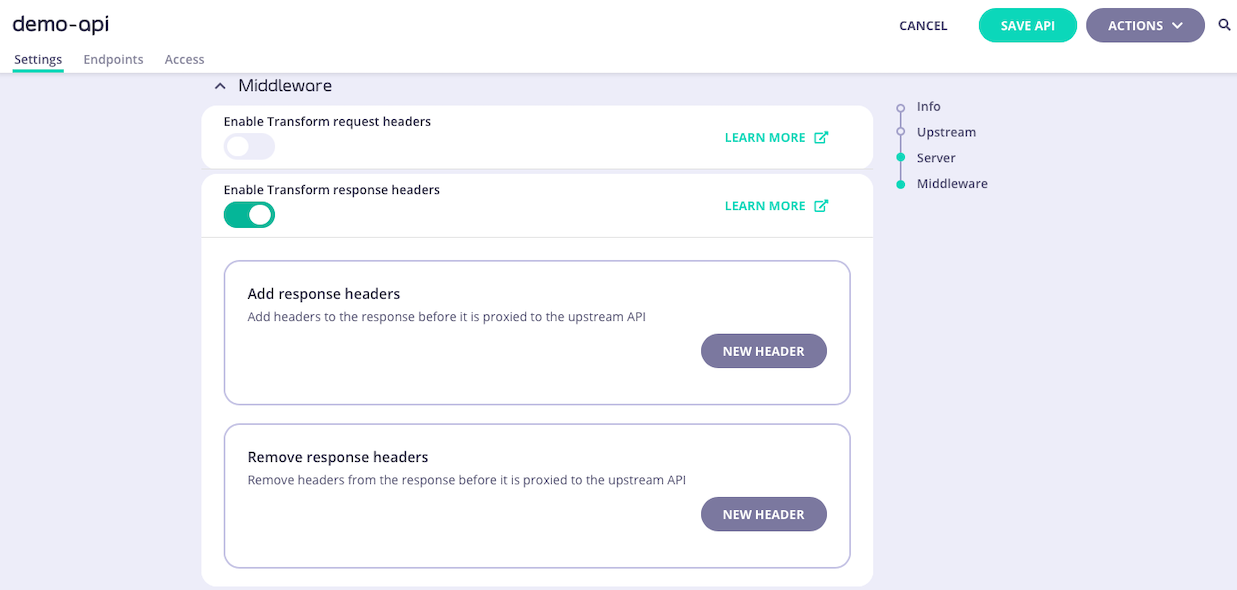 Then select **NEW HEADER** as appropriate to add or remove a header from API responses. You can add or remove multiple headers by selecting **ADD HEADER** to add another to the list:
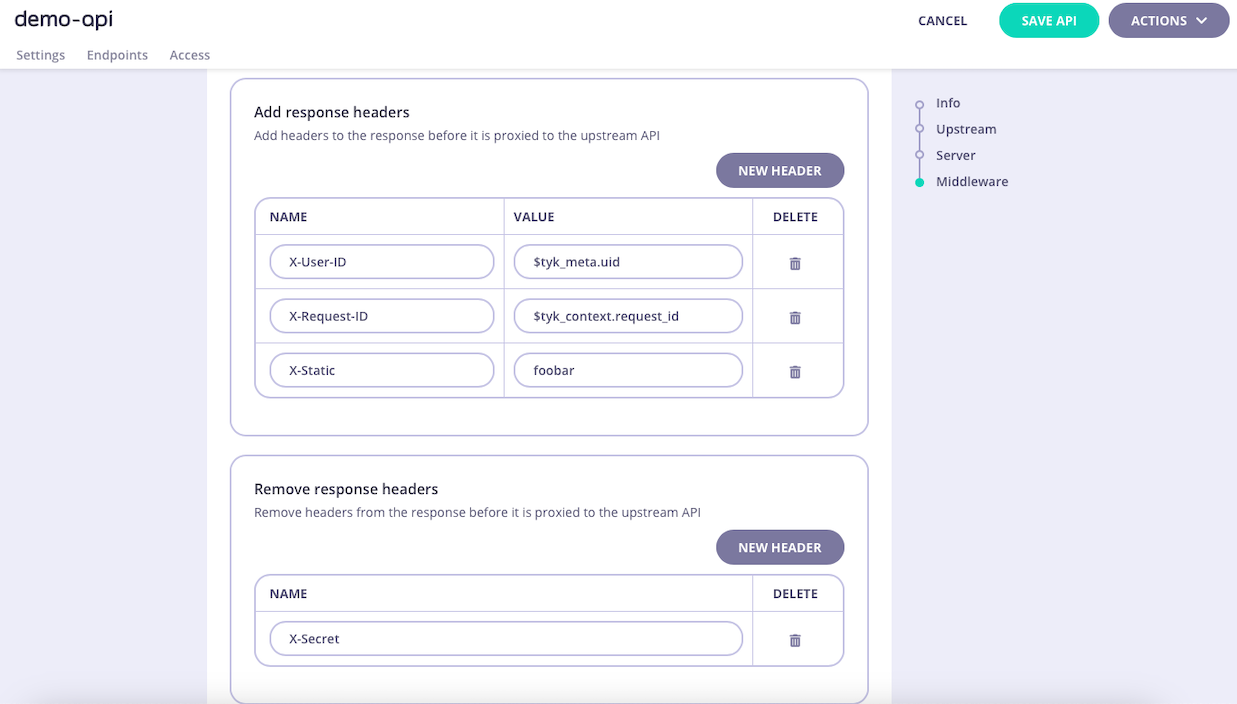 #### Adding an endpoint level transform
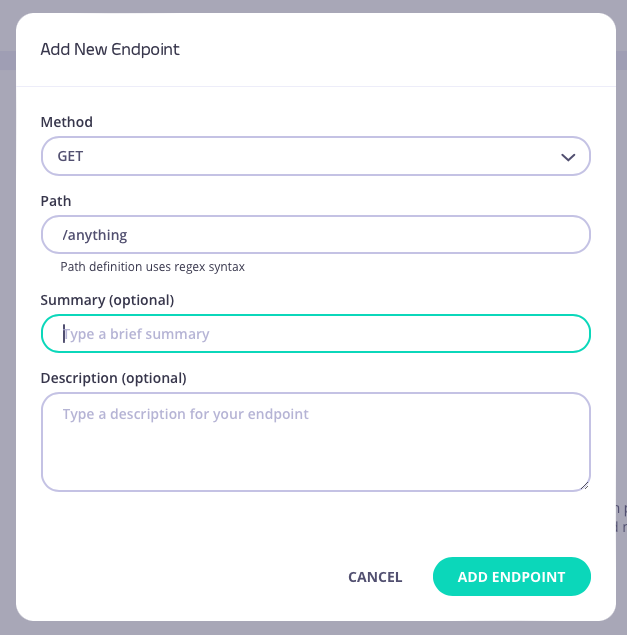
1. **Add an endpoint**
From the **API Designer** add an endpoint that matches the path and method to which you want to apply the middleware.
#### Adding an endpoint level transform
1. **Add an endpoint**
From the **API Designer** add an endpoint that matches the path and method to which you want to apply the middleware.

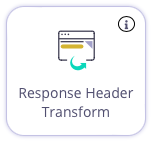
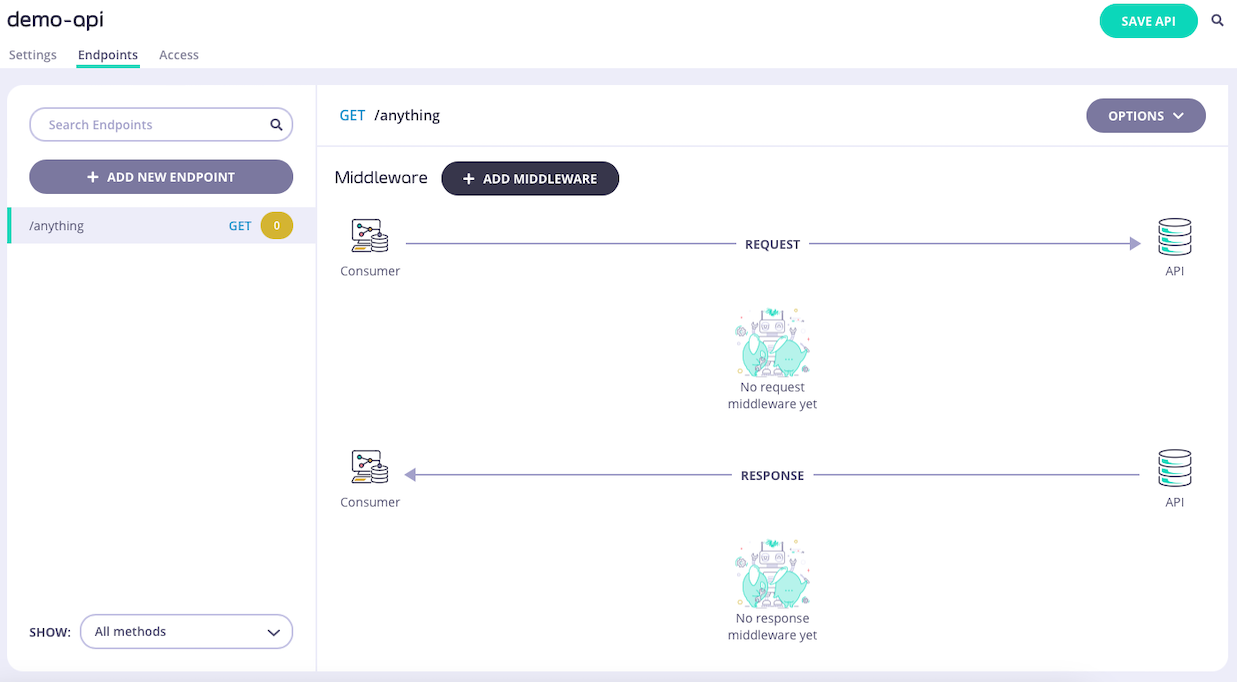 2. **Select the Response Header Transform middleware**
Select **ADD MIDDLEWARE** and choose the **Response Header Transform** middleware from the *Add Middleware* screen.
2. **Select the Response Header Transform middleware**
Select **ADD MIDDLEWARE** and choose the **Response Header Transform** middleware from the *Add Middleware* screen.
 3. **Configure header transformation**
Select **NEW HEADER** to configure a header to be added to or removed from the response, you can add multiple headers to either list by selecting **NEW HEADER** again.
3. **Configure header transformation**
Select **NEW HEADER** to configure a header to be added to or removed from the response, you can add multiple headers to either list by selecting **NEW HEADER** again.

 4. **Save the API**
Select **ADD MIDDLEWARE** to save the middleware configuration. Remember to select **SAVE API** to apply the changes.
## Using Classic
Tyk's [response header transform](/5.12/api-management/traffic-transformation/response-headers) middleware enables you to append or delete headers on responses received from the upstream service before sending them to the client.
There are two options for this:
* API-level modification that is applied to all responses for the API
* endpoint-level modification that is applied only to responses from a specific endpoint
If both API-level and endpoint-level middleware are configured, the endpoint-level transformation will be applied first.
When working with Tyk Classic APIs the transformation is configured in the Tyk Classic API Definition. You can do this via the Tyk Dashboard API or in the API Designer.
If you want to use dynamic data from context variables, you must [enable](/5.12/api-management/traffic-transformation/request-context-variables#enabling-context-variables-for-use-with-tyk-classic-apis) context variables for the API to be able to access them from the response header transform middleware.
If you're using the newer Tyk OAS APIs, then check out the [Tyk OAS](/5.12/#response-headers-using-tyk-oas) page.
If you're using Tyk Operator then check out the [configuring the Response Header Transform in Tyk Operator](/5.12/#tyk-operator) section below.
### API Definition
The API-level and endpoint-level response header transforms have a common configuration but are configured in different sections of the API definition.
Prior to Tyk 5.3.0, there was an additional step to enable response header transforms (both API-level and endpoint-level). You would need to add the following to the Tyk Classic API definition:
```json theme={null}
{
"response_processors":[
{"name": "header_injector"}
]
}
```
If using the Endpoint Designer in the Tyk Dashboard, this would be added automatically.
We removed the need to configure the `response_processors` element in Tyk 5.3.0.
#### API-level transform
To **append** headers to all responses from your API (i.e. for all endpoints) you must add a new `global_response_headers` object to the `versions` section of your API definition. This contains a list of key:value pairs, being the names and values of the headers to be added to responses.
To **delete** headers from all responses from your API (i.e. for all endpoints), you must add a new `global_response_headers_remove` object to the `versions` section of the API definition. This contains a list of the names of existing headers to be removed from responses.
For example:
```json {linenos=true, linenostart=1} theme={null}
{
"version_data": {
"versions": {
"Default": {
"global_response_headers": {
"X-Static": "foobar",
"X-Request-ID":"$tyk_context.request_id",
"X-User-ID": "$tyk_meta.uid"
},
"global_response_headers_remove": [
"X-Secret"
]
}
}
},
}
```
This configuration will add three new headers to each response:
* `X-Static` with the value `foobar`
* `X-Request-ID` with a dynamic value taken from the `request_id` [context variable](/5.12/api-management/traffic-transformation/request-context-variables)
* `X-User-ID` with a dynamic value taken from the `uid` field in the [session metadata](/5.12/api-management/policies#what-is-a-session-metadata)
It will also delete one header (if present) from each response:
* `X-Secret`
#### Endpoint-level transform
To configure response header transformation for a specific endpoint you must add a new `transform_response_headers` object to the `extended_paths` section of your API definition.
It has the following configuration:
* `path`: the endpoint path
* `method`: the endpoint HTTP method
* `delete_headers`: a list of the headers that should be deleted from the response
* `add_headers`: a list of headers, in key:value pairs, that should be added to the response
For example:
```json {linenos=true, linenostart=1} theme={null}
{
"transform_response_headers": [
{
"path": "status/200",
"method": "GET",
"delete_headers": ["X-Static"],
"add_headers": [
{"X-Secret": "the-secret-key-is-secret"},
{"X-New": "another-header"}
],
}
]
}
```
In this example the Response Header Transform middleware has been configured for HTTP `GET` requests to the `/status/200` endpoint. Any response received from the upstream service following a request to that endpoint will have the `X-Static` header removed and the `X-Secret` and `X-New` headers added (with values set to `the-secret-key-is-secret` and `another-header`).
#### Combining API-level and Endpoint-level transforms
If the example [API-level](/5.12/#api-level-transform) and [endpoint-level](/5.12/#endpoint-level-transform) transforms are applied to the same API, then the `X-Secret` header will be added (by the endpoint-level transform first) and then removed (by the API-level transform). Subsequently, the result of the two transforms for a call to `GET /status/200` would be to add four headers:
* `X-Request-ID`
* `X-User-ID`
* `X-Static`
* `X-New`
#### Fixing response headers that leak upstream server data
A middleware called `header_transform` was added in Tyk 2.1 specfically to allow you to ensure that headers such as `Location` and `Link` reflect the outward facade of your API Gateway and also align with the expected response location to be terminated at the gateway, not the hidden upstream proxy.
This is configured by adding a new `rev_proxy_header_cleanup` object to the `response_processors` section of your API definition.
It has the following configuration:
* `headers`: a list of headers in the response that should be modified
* `target_host`: the value to which the listed headers should be updated
For example:
```json theme={null}
{
"response_processors": [
{
"name": "header_transform",
"options": {
"rev_proxy_header_cleanup": {
"headers": ["Link", "Location"],
"target_host": "http://TykHost:TykPort"
}
}
}
]
}
```
In this example, the `Link` and `Location` headers will be modified from the server-generated response, with the protocol, domain and port of the value set in `target_host`.
This feature is rarely used and has not been implemented in the Tyk Dashboard UI, nor in the [Tyk OAS API](/5.12/#response-headers-using-tyk-oas).
### API Designer
You can use the API Designer in the Tyk Dashboard to configure the response header transform middleware for your Tyk Classic API by following these steps.
#### API-level transform
Configuring the API-level response header transform middleware is very simple when using the Tyk Dashboard.
In the Endpoint Designer you should select the **Global Version Settings** and ensure that you have selected the **Response Headers** tab:
4. **Save the API**
Select **ADD MIDDLEWARE** to save the middleware configuration. Remember to select **SAVE API** to apply the changes.
## Using Classic
Tyk's [response header transform](/5.12/api-management/traffic-transformation/response-headers) middleware enables you to append or delete headers on responses received from the upstream service before sending them to the client.
There are two options for this:
* API-level modification that is applied to all responses for the API
* endpoint-level modification that is applied only to responses from a specific endpoint
If both API-level and endpoint-level middleware are configured, the endpoint-level transformation will be applied first.
When working with Tyk Classic APIs the transformation is configured in the Tyk Classic API Definition. You can do this via the Tyk Dashboard API or in the API Designer.
If you want to use dynamic data from context variables, you must [enable](/5.12/api-management/traffic-transformation/request-context-variables#enabling-context-variables-for-use-with-tyk-classic-apis) context variables for the API to be able to access them from the response header transform middleware.
If you're using the newer Tyk OAS APIs, then check out the [Tyk OAS](/5.12/#response-headers-using-tyk-oas) page.
If you're using Tyk Operator then check out the [configuring the Response Header Transform in Tyk Operator](/5.12/#tyk-operator) section below.
### API Definition
The API-level and endpoint-level response header transforms have a common configuration but are configured in different sections of the API definition.
Prior to Tyk 5.3.0, there was an additional step to enable response header transforms (both API-level and endpoint-level). You would need to add the following to the Tyk Classic API definition:
```json theme={null}
{
"response_processors":[
{"name": "header_injector"}
]
}
```
If using the Endpoint Designer in the Tyk Dashboard, this would be added automatically.
We removed the need to configure the `response_processors` element in Tyk 5.3.0.
#### API-level transform
To **append** headers to all responses from your API (i.e. for all endpoints) you must add a new `global_response_headers` object to the `versions` section of your API definition. This contains a list of key:value pairs, being the names and values of the headers to be added to responses.
To **delete** headers from all responses from your API (i.e. for all endpoints), you must add a new `global_response_headers_remove` object to the `versions` section of the API definition. This contains a list of the names of existing headers to be removed from responses.
For example:
```json {linenos=true, linenostart=1} theme={null}
{
"version_data": {
"versions": {
"Default": {
"global_response_headers": {
"X-Static": "foobar",
"X-Request-ID":"$tyk_context.request_id",
"X-User-ID": "$tyk_meta.uid"
},
"global_response_headers_remove": [
"X-Secret"
]
}
}
},
}
```
This configuration will add three new headers to each response:
* `X-Static` with the value `foobar`
* `X-Request-ID` with a dynamic value taken from the `request_id` [context variable](/5.12/api-management/traffic-transformation/request-context-variables)
* `X-User-ID` with a dynamic value taken from the `uid` field in the [session metadata](/5.12/api-management/policies#what-is-a-session-metadata)
It will also delete one header (if present) from each response:
* `X-Secret`
#### Endpoint-level transform
To configure response header transformation for a specific endpoint you must add a new `transform_response_headers` object to the `extended_paths` section of your API definition.
It has the following configuration:
* `path`: the endpoint path
* `method`: the endpoint HTTP method
* `delete_headers`: a list of the headers that should be deleted from the response
* `add_headers`: a list of headers, in key:value pairs, that should be added to the response
For example:
```json {linenos=true, linenostart=1} theme={null}
{
"transform_response_headers": [
{
"path": "status/200",
"method": "GET",
"delete_headers": ["X-Static"],
"add_headers": [
{"X-Secret": "the-secret-key-is-secret"},
{"X-New": "another-header"}
],
}
]
}
```
In this example the Response Header Transform middleware has been configured for HTTP `GET` requests to the `/status/200` endpoint. Any response received from the upstream service following a request to that endpoint will have the `X-Static` header removed and the `X-Secret` and `X-New` headers added (with values set to `the-secret-key-is-secret` and `another-header`).
#### Combining API-level and Endpoint-level transforms
If the example [API-level](/5.12/#api-level-transform) and [endpoint-level](/5.12/#endpoint-level-transform) transforms are applied to the same API, then the `X-Secret` header will be added (by the endpoint-level transform first) and then removed (by the API-level transform). Subsequently, the result of the two transforms for a call to `GET /status/200` would be to add four headers:
* `X-Request-ID`
* `X-User-ID`
* `X-Static`
* `X-New`
#### Fixing response headers that leak upstream server data
A middleware called `header_transform` was added in Tyk 2.1 specfically to allow you to ensure that headers such as `Location` and `Link` reflect the outward facade of your API Gateway and also align with the expected response location to be terminated at the gateway, not the hidden upstream proxy.
This is configured by adding a new `rev_proxy_header_cleanup` object to the `response_processors` section of your API definition.
It has the following configuration:
* `headers`: a list of headers in the response that should be modified
* `target_host`: the value to which the listed headers should be updated
For example:
```json theme={null}
{
"response_processors": [
{
"name": "header_transform",
"options": {
"rev_proxy_header_cleanup": {
"headers": ["Link", "Location"],
"target_host": "http://TykHost:TykPort"
}
}
}
]
}
```
In this example, the `Link` and `Location` headers will be modified from the server-generated response, with the protocol, domain and port of the value set in `target_host`.
This feature is rarely used and has not been implemented in the Tyk Dashboard UI, nor in the [Tyk OAS API](/5.12/#response-headers-using-tyk-oas).
### API Designer
You can use the API Designer in the Tyk Dashboard to configure the response header transform middleware for your Tyk Classic API by following these steps.
#### API-level transform
Configuring the API-level response header transform middleware is very simple when using the Tyk Dashboard.
In the Endpoint Designer you should select the **Global Version Settings** and ensure that you have selected the **Response Headers** tab:
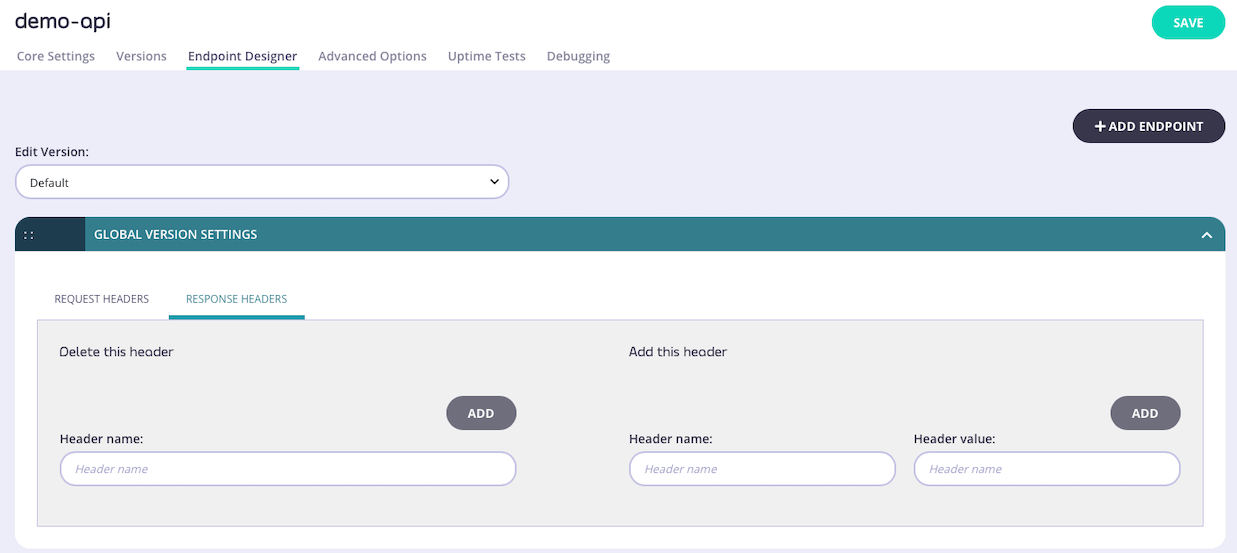 Note that you must click **ADD** to add a header to the list (for appending or deletion).
#### Endpoint-level transform
1. **Add an endpoint for the path and select the Header Transform plugin**
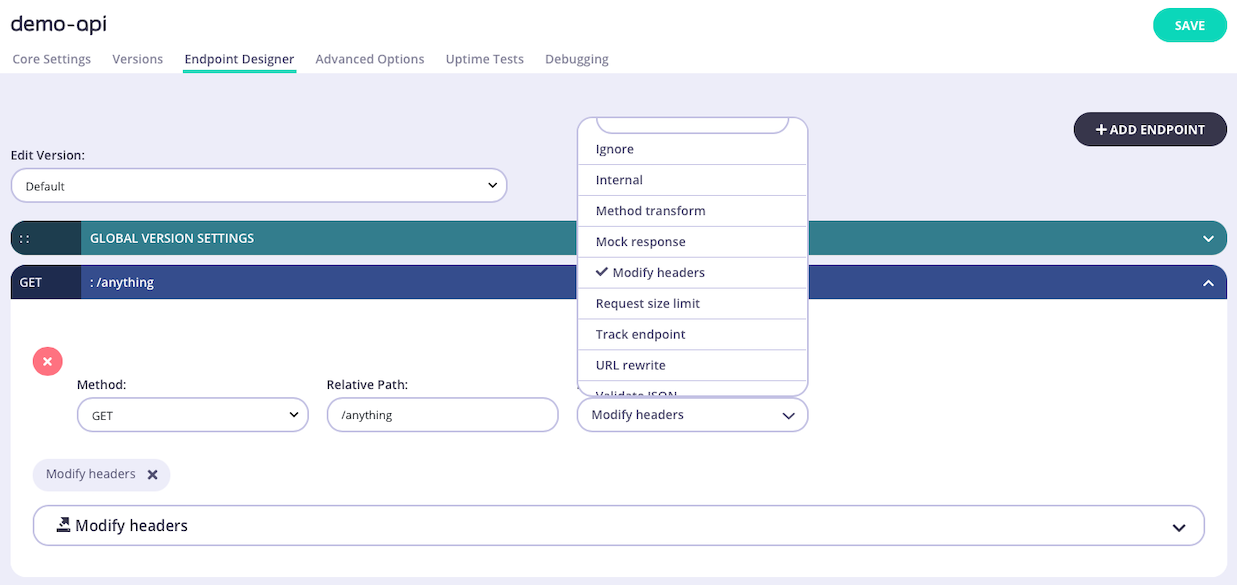
From the **Endpoint Designer** add an endpoint that matches the path for which you want to perform the transformation. Select the **Modify Headers** plugin.
Note that you must click **ADD** to add a header to the list (for appending or deletion).
#### Endpoint-level transform
1. **Add an endpoint for the path and select the Header Transform plugin**
From the **Endpoint Designer** add an endpoint that matches the path for which you want to perform the transformation. Select the **Modify Headers** plugin.
 2. **Select the "Response" tab**
This ensures that the transform will be applied to responses prior to them being sent to the client.
2. **Select the "Response" tab**
This ensures that the transform will be applied to responses prior to them being sent to the client.
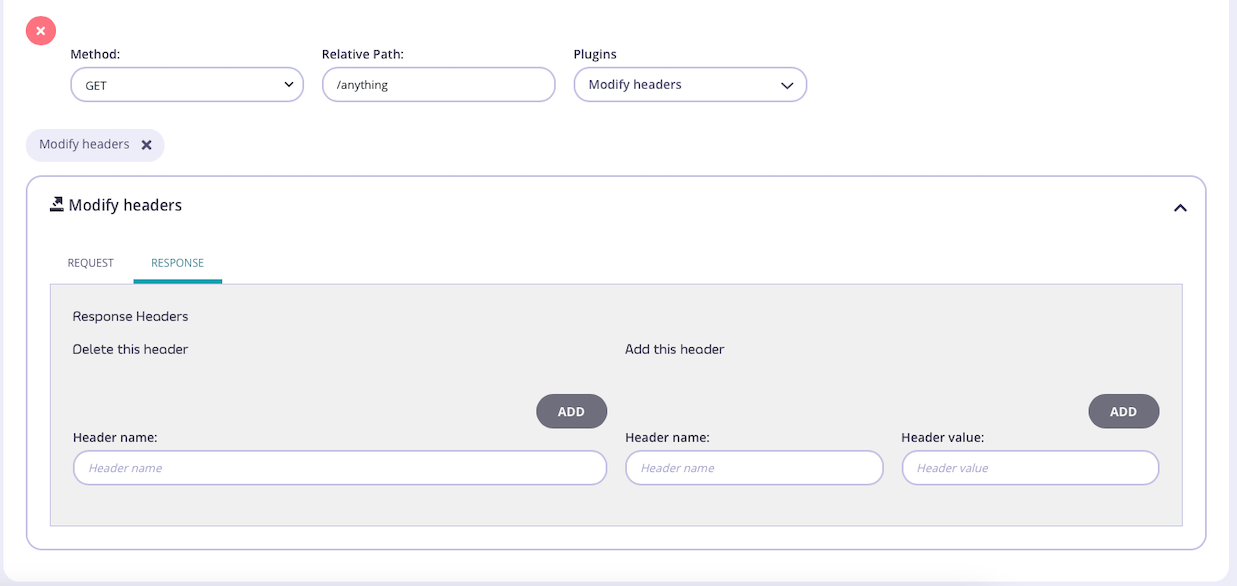 3. **Declare the headers to be modified**
Select the headers to delete and insert using the provided fields. You need to click **ADD** to ensure they are added to the list.
3. **Declare the headers to be modified**
Select the headers to delete and insert using the provided fields. You need to click **ADD** to ensure they are added to the list.
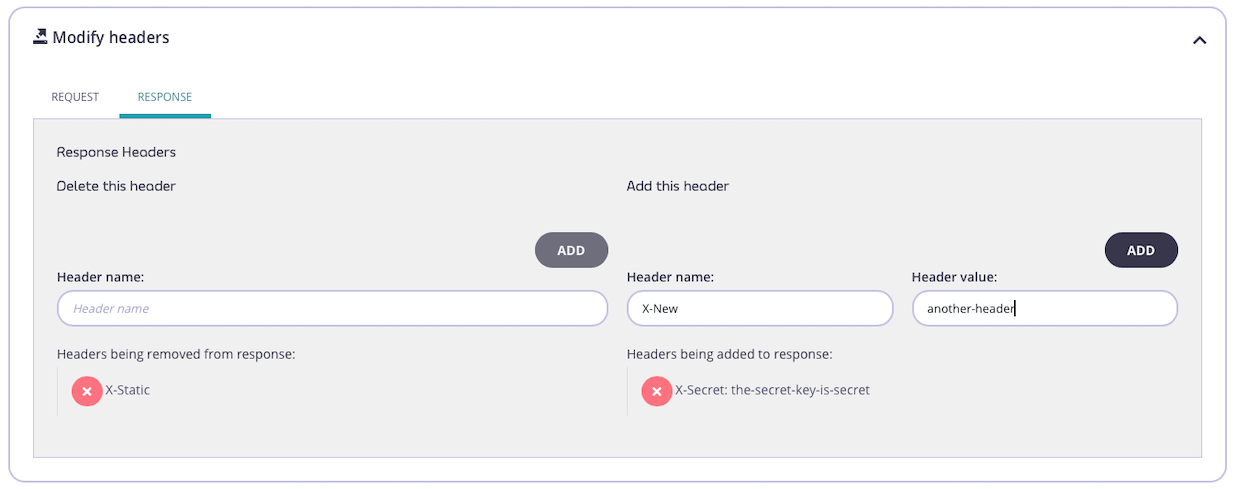 4. **Save the API**
Use the *save* or *create* buttons to save the changes and activate the middleware.
### Tyk Operator
The process for configuring a response header transform in Tyk Operator is similar to that defined in section configuring the Response Header Transform in the Tyk Classic API Definition. Tyk Operator allows you to configure a response header transformation for [all endpoints of an API](/5.12/#tyk-operator-endpoint) or for a [specific API endpoint](/5.12/#tyk-operator-api).
#### API-level transform
The process of configuring transformation of response headers for a specific API in Tyk Operator is similar to that defined in section [API-level transform](/5.12/#tyk-classic-api) for the Tyk Classic API definition.
To **append** headers to all responses from your API (i.e. for all endpoints) you must add a new `global_response_headers` object to the `versions` section of your API definition. This contains a list of key:value pairs, being the names and values of the headers to be added to responses.
To **delete** headers from all responses from your API (i.e. for all endpoints), you must add a new `global_response_headers_remove` object to the `versions` section of the API definition. This contains a list of the names of existing headers to be removed from responses.
An example is listed below:
```yaml {linenos=true, linenostart=1, hl_lines=["25-30"]} theme={null}
apiVersion: tyk.tyk.io/v1alpha1
kind: ApiDefinition
metadata:
name: httpbin-global-header
spec:
name: httpbin-global-header
use_keyless: true
protocol: http
active: true
proxy:
target_url: http://httpbin.org
listen_path: /httpbin-global-header
strip_listen_path: true
version_data:
default_version: Default
not_versioned: true
versions:
Default:
name: Default
use_extended_paths: true
paths:
black_list: []
ignored: []
white_list: []
global_response_headers:
X-Static: foobar
X-Request-ID: "$tyk_context.request_id"
X-User-ID: "$tyk_meta.uid"
global_response_headers_remove:
- X-Secret
```
The example API Definition above configures an API to listen on path `/httpbin-global-header` and forwards requests upstream to [http://httpbin.org](http://httpbin.org).
This configuration will add three new headers to each response:
* `X-Static` with the value `foobar`
* `X-Request-ID` with a dynamic value taken from the `request_id` [context variable](/5.12/api-management/traffic-transformation/request-context-variables)
* `X-User-ID` with a dynamic value taken from the `uid` field in the [session metadata](/5.12/api-management/policies#what-is-a-session-metadata)
It will also delete one header (if present) from each response:
* `X-Secret`
#### Endpoint-level transform
The process of configuring a transformation of a response header for a specific endpoint in Tyk Operator is similar to that defined in section [endpoint-level transform](/5.12/#tyk-classic-endpoint) for the Tyk Classic API definition. To configure a transformation of the response headers for a specific endpoint you must add a new `transform_response_headers` object to the `extended_paths` section of your API definition.
In this example the Response Header Transform middleware (`transform_response_headers`) has been configured for HTTP `GET` requests to the `/xml` endpoint. Any response received from the upstream service following a request to that endpoint will have the `Content-Type` header added with a value set to `application/json`.
#### Example
```yaml {linenos=true, linenostart=1, hl_lines=["54-60"]} theme={null}
apiVersion: tyk.tyk.io/v1alpha1
kind: ApiDefinition
metadata:
name: httpbin-transform
spec:
name: httpbin-transform
use_keyless: true
protocol: http
active: true
proxy:
target_url: http://httpbin.org
listen_path: /httpbin-transform
strip_listen_path: true
version_data:
default_version: Default
not_versioned: true
versions:
Default:
name: Default
use_extended_paths: true
paths:
black_list: []
ignored: []
white_list: []
extended_paths:
transform:
- method: POST
path: /anything
template_data:
enable_session: false
input_type: json
template_mode: blob
# base64 encoded template
template_source: eyJiYXIiOiAie3suZm9vfX0ifQ==
transform_headers:
- delete_headers:
- "remove_this"
add_headers:
foo: bar
path: /anything
method: POST
transform_response:
- method: GET
path: /xml
template_data:
enable_session: false
input_type: xml
template_mode: blob
# base64 encoded template
template_source: e3sgLiB8IGpzb25NYXJzaGFsIH19
transform_response_headers:
- method: GET
path: /xml
add_headers:
Content-Type: "application/json"
act_on: false
delete_headers: []
```
#### Tyk Gateway \< 5.3.0 Example
If using Tyk Gateway \< v5.3.0 then a `response_processor` object must be added to the API definition containing a `header_injector` item, as highlighted below:
```yaml {linenos=true, linenostart=1, hl_lines=["17", "19", "57-63"]} theme={null}
apiVersion: tyk.tyk.io/v1alpha1
kind: ApiDefinition
metadata:
name: httpbin-transform
spec:
name: httpbin-transform
use_keyless: true
protocol: http
active: true
proxy:
target_url: http://httpbin.org
listen_path: /httpbin-transform
strip_listen_path: true
response_processors:
- name: response_body_transform
- name: header_injector
version_data:
default_version: Default
not_versioned: true
versions:
Default:
name: Default
use_extended_paths: true
paths:
black_list: []
ignored: []
white_list: []
extended_paths:
transform:
- method: POST
path: /anything
template_data:
enable_session: false
input_type: json
template_mode: blob
# base64 encoded template
template_source: eyJiYXIiOiAie3suZm9vfX0ifQ==
transform_headers:
- delete_headers:
- "remove_this"
add_headers:
foo: bar
path: /anything
method: POST
transform_response:
- method: GET
path: /xml
template_data:
enable_session: false
input_type: xml
template_mode: blob
# base64 encoded template
template_source: e3sgLiB8IGpzb25NYXJzaGFsIH19
transform_response_headers:
- method: GET
path: /xml
add_headers:
Content-Type: "application/json"
act_on: false
delete_headers: []
```
4. **Save the API**
Use the *save* or *create* buttons to save the changes and activate the middleware.
### Tyk Operator
The process for configuring a response header transform in Tyk Operator is similar to that defined in section configuring the Response Header Transform in the Tyk Classic API Definition. Tyk Operator allows you to configure a response header transformation for [all endpoints of an API](/5.12/#tyk-operator-endpoint) or for a [specific API endpoint](/5.12/#tyk-operator-api).
#### API-level transform
The process of configuring transformation of response headers for a specific API in Tyk Operator is similar to that defined in section [API-level transform](/5.12/#tyk-classic-api) for the Tyk Classic API definition.
To **append** headers to all responses from your API (i.e. for all endpoints) you must add a new `global_response_headers` object to the `versions` section of your API definition. This contains a list of key:value pairs, being the names and values of the headers to be added to responses.
To **delete** headers from all responses from your API (i.e. for all endpoints), you must add a new `global_response_headers_remove` object to the `versions` section of the API definition. This contains a list of the names of existing headers to be removed from responses.
An example is listed below:
```yaml {linenos=true, linenostart=1, hl_lines=["25-30"]} theme={null}
apiVersion: tyk.tyk.io/v1alpha1
kind: ApiDefinition
metadata:
name: httpbin-global-header
spec:
name: httpbin-global-header
use_keyless: true
protocol: http
active: true
proxy:
target_url: http://httpbin.org
listen_path: /httpbin-global-header
strip_listen_path: true
version_data:
default_version: Default
not_versioned: true
versions:
Default:
name: Default
use_extended_paths: true
paths:
black_list: []
ignored: []
white_list: []
global_response_headers:
X-Static: foobar
X-Request-ID: "$tyk_context.request_id"
X-User-ID: "$tyk_meta.uid"
global_response_headers_remove:
- X-Secret
```
The example API Definition above configures an API to listen on path `/httpbin-global-header` and forwards requests upstream to [http://httpbin.org](http://httpbin.org).
This configuration will add three new headers to each response:
* `X-Static` with the value `foobar`
* `X-Request-ID` with a dynamic value taken from the `request_id` [context variable](/5.12/api-management/traffic-transformation/request-context-variables)
* `X-User-ID` with a dynamic value taken from the `uid` field in the [session metadata](/5.12/api-management/policies#what-is-a-session-metadata)
It will also delete one header (if present) from each response:
* `X-Secret`
#### Endpoint-level transform
The process of configuring a transformation of a response header for a specific endpoint in Tyk Operator is similar to that defined in section [endpoint-level transform](/5.12/#tyk-classic-endpoint) for the Tyk Classic API definition. To configure a transformation of the response headers for a specific endpoint you must add a new `transform_response_headers` object to the `extended_paths` section of your API definition.
In this example the Response Header Transform middleware (`transform_response_headers`) has been configured for HTTP `GET` requests to the `/xml` endpoint. Any response received from the upstream service following a request to that endpoint will have the `Content-Type` header added with a value set to `application/json`.
#### Example
```yaml {linenos=true, linenostart=1, hl_lines=["54-60"]} theme={null}
apiVersion: tyk.tyk.io/v1alpha1
kind: ApiDefinition
metadata:
name: httpbin-transform
spec:
name: httpbin-transform
use_keyless: true
protocol: http
active: true
proxy:
target_url: http://httpbin.org
listen_path: /httpbin-transform
strip_listen_path: true
version_data:
default_version: Default
not_versioned: true
versions:
Default:
name: Default
use_extended_paths: true
paths:
black_list: []
ignored: []
white_list: []
extended_paths:
transform:
- method: POST
path: /anything
template_data:
enable_session: false
input_type: json
template_mode: blob
# base64 encoded template
template_source: eyJiYXIiOiAie3suZm9vfX0ifQ==
transform_headers:
- delete_headers:
- "remove_this"
add_headers:
foo: bar
path: /anything
method: POST
transform_response:
- method: GET
path: /xml
template_data:
enable_session: false
input_type: xml
template_mode: blob
# base64 encoded template
template_source: e3sgLiB8IGpzb25NYXJzaGFsIH19
transform_response_headers:
- method: GET
path: /xml
add_headers:
Content-Type: "application/json"
act_on: false
delete_headers: []
```
#### Tyk Gateway \< 5.3.0 Example
If using Tyk Gateway \< v5.3.0 then a `response_processor` object must be added to the API definition containing a `header_injector` item, as highlighted below:
```yaml {linenos=true, linenostart=1, hl_lines=["17", "19", "57-63"]} theme={null}
apiVersion: tyk.tyk.io/v1alpha1
kind: ApiDefinition
metadata:
name: httpbin-transform
spec:
name: httpbin-transform
use_keyless: true
protocol: http
active: true
proxy:
target_url: http://httpbin.org
listen_path: /httpbin-transform
strip_listen_path: true
response_processors:
- name: response_body_transform
- name: header_injector
version_data:
default_version: Default
not_versioned: true
versions:
Default:
name: Default
use_extended_paths: true
paths:
black_list: []
ignored: []
white_list: []
extended_paths:
transform:
- method: POST
path: /anything
template_data:
enable_session: false
input_type: json
template_mode: blob
# base64 encoded template
template_source: eyJiYXIiOiAie3suZm9vfX0ifQ==
transform_headers:
- delete_headers:
- "remove_this"
add_headers:
foo: bar
path: /anything
method: POST
transform_response:
- method: GET
path: /xml
template_data:
enable_session: false
input_type: xml
template_mode: blob
# base64 encoded template
template_source: e3sgLiB8IGpzb25NYXJzaGFsIH19
transform_response_headers:
- method: GET
path: /xml
add_headers:
Content-Type: "application/json"
act_on: false
delete_headers: []
```