> ## Documentation Index
> Fetch the complete documentation index at: https://tyk.io/docs/llms.txt
> Use this file to discover all available pages before exploring further.
# Getting Started with Tyk AI Studio
> In this guide, we will walk through the initial configuration steps after deploying Tyk AI Studio, including logging in, connecting an LLM provider, and starting your first chat.
## Availability
| Edition | Deployment Type |
| :---------------------------------------------------------------------------------------------------------------------------------------------- | :------------------- |
| [Community](/5.12/ai-management/ai-studio/overview#community-edition) & [Enterprise](/5.12/ai-management/ai-studio/overview#enterprise-edition) | Self-Managed, Hybrid |
This guide assumes you are logged in as a **Studio Administrator** with full permissions to configure the system.
## 1. Login to the AI Studio
After completing the [installation process](/5.12/ai-management/ai-studio/quickstart) and registering your first user:
1. **Access the UI:** Open your web browser and navigate to your configured `SITE_URL`
2. **Admin Login:** Log in using the administrator account you created during registration:
 **Reminder**: If you haven't completed the initial registration yet, go back to your [installation guide](/5.12/ai-management/ai-studio/quickstart#first-user-registration) and follow the "First User Registration" section.
## 2. Configure Your First LLM
One of the most common initial steps is connecting Tyk AI Studio to an LLM provider.
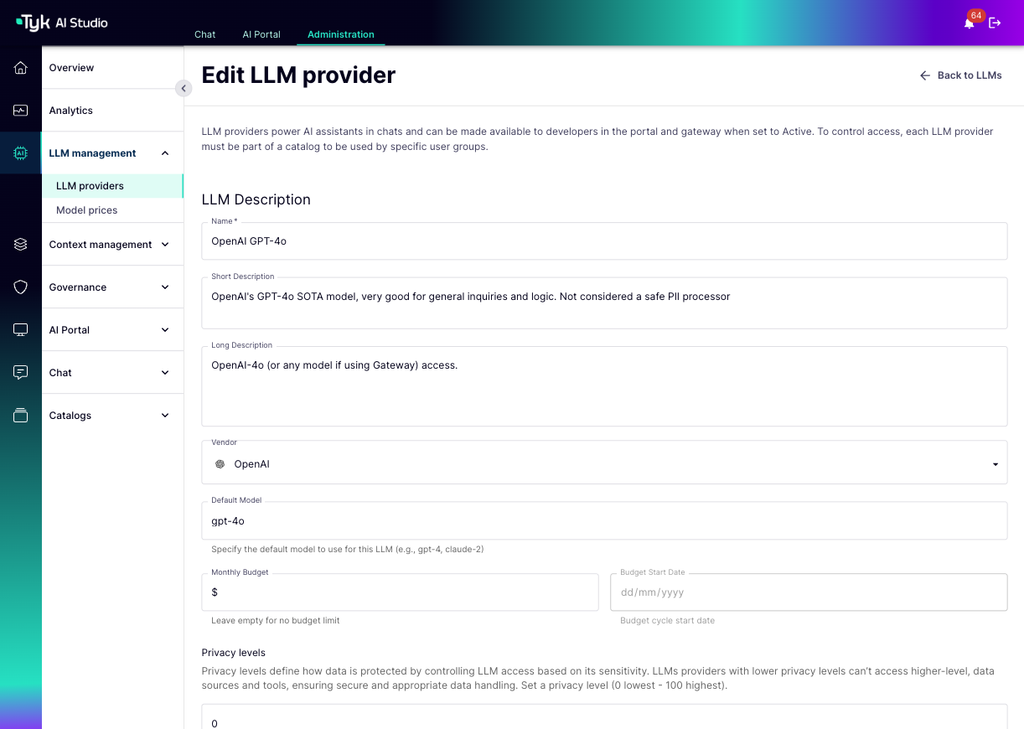
1. **Navigate to LLM Management:** In the admin UI sidebar, select **LLM Management > LLM Providers**.
2. **Add LLM Configuration:** Click the button to add a new LLM Configuration.
3. **Enter Details:**
* **Configuration Name:** Give it a recognizable name (e.g., `OpenAI-GPT-4o`).
* **Description:** Optionally, add a description for this configuration.
* **Select Vendor:** Choose the LLM provider you want to connect (e.g., OpenAI, Anthropic, Azure OpenAI).
* **Select Default Model:** Specify the exact model identifier(s) provided by the vendor (e.g., `gpt-4o`, `gpt-4-turbo`).
* Add API Key in the **Access Details** section:
Do *not* paste your API key directly here. Instead, use [Secrets Management](/5.12/ai-management/ai-studio/secrets).
* If you haven't already, go to the **Secrets** section in the admin UI and create a new secret:
* **Variable Name:** `OPENAI_API_KEY` (or similar)
* **Secret Value:** Paste your actual OpenAI API key here.
* Save the secret.
* Return to the LLM Configuration screen.
* In the API Key field, enter the secret reference: `$SECRET/OPENAI_API_KEY` (using the exact Variable Name you created).
* **Other Parameters:** Configure any other provider-specific settings (e.g., Base URL for Azure/custom endpoints, default temperature, etc.).
4. **Save:** Save the LLM configuration.
**Reminder**: If you haven't completed the initial registration yet, go back to your [installation guide](/5.12/ai-management/ai-studio/quickstart#first-user-registration) and follow the "First User Registration" section.
## 2. Configure Your First LLM
One of the most common initial steps is connecting Tyk AI Studio to an LLM provider.
1. **Navigate to LLM Management:** In the admin UI sidebar, select **LLM Management > LLM Providers**.
2. **Add LLM Configuration:** Click the button to add a new LLM Configuration.
3. **Enter Details:**
* **Configuration Name:** Give it a recognizable name (e.g., `OpenAI-GPT-4o`).
* **Description:** Optionally, add a description for this configuration.
* **Select Vendor:** Choose the LLM provider you want to connect (e.g., OpenAI, Anthropic, Azure OpenAI).
* **Select Default Model:** Specify the exact model identifier(s) provided by the vendor (e.g., `gpt-4o`, `gpt-4-turbo`).
* Add API Key in the **Access Details** section:
Do *not* paste your API key directly here. Instead, use [Secrets Management](/5.12/ai-management/ai-studio/secrets).
* If you haven't already, go to the **Secrets** section in the admin UI and create a new secret:
* **Variable Name:** `OPENAI_API_KEY` (or similar)
* **Secret Value:** Paste your actual OpenAI API key here.
* Save the secret.
* Return to the LLM Configuration screen.
* In the API Key field, enter the secret reference: `$SECRET/OPENAI_API_KEY` (using the exact Variable Name you created).
* **Other Parameters:** Configure any other provider-specific settings (e.g., Base URL for Azure/custom endpoints, default temperature, etc.).
4. **Save:** Save the LLM configuration.
 After adding and saving an LLM vendor, it is added to the default Catalog, making it available to [users](/5.12/ai-management/ai-studio/user-management) who have access to the default Catalog.
For more details, see the [LLM Management](/5.12/ai-management/ai-studio/llm-management) documentation.
## 3. Create Chat Experience
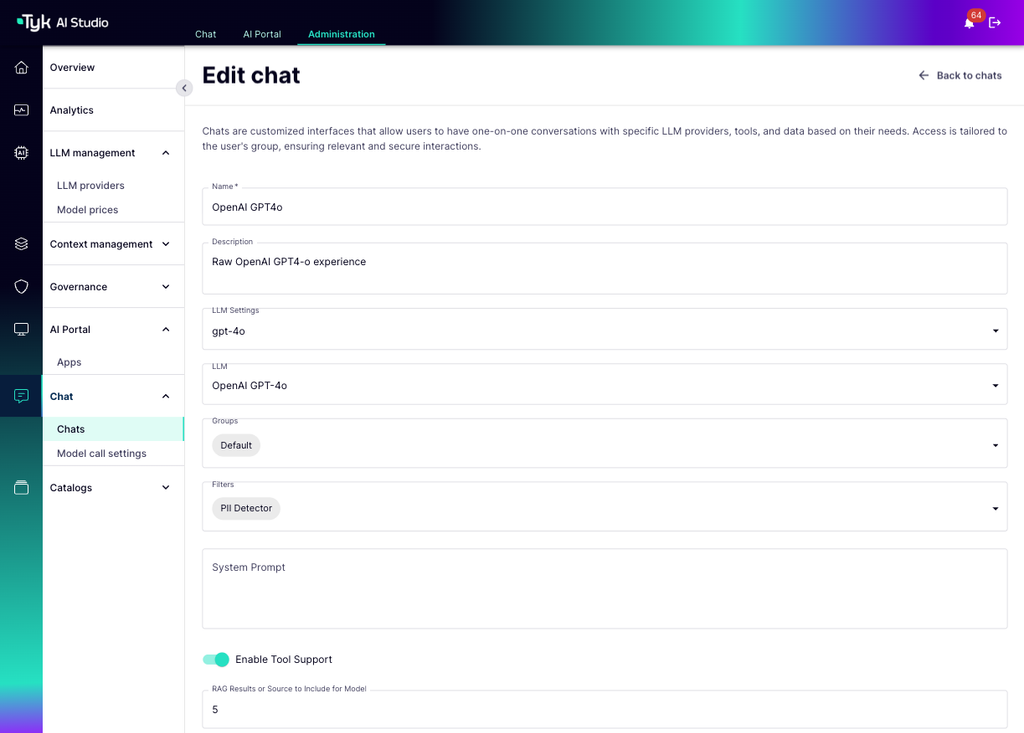
1. Navigate to the **Chats > Chats** section in the admin UI.
2. Click to create a new Chat Experience.
* **Name:** Give your chat a descriptive name (e.g., `OpenAPI GPT4o`).
* **LLM Call settings:** Select the [LLM Call settings](/5.12/ai-management/ai-studio/call-settings) you want to use for this chat (e.g., `gpt-4o`). If the specific model settings are not available, you can create one in the [LLM model settings](/5.12/ai-management/ai-studio/call-settings#how-to-create-llm-call-settings) page. We have added defaults for the popular ones.
* **Select LLM vendor:** Select the LLM configuration you created in the previous step.
* **Select Group**: Assign this chat to a specific Group or select "Default" to make it available to all users.
3. Save the new Chat Experience.
After adding and saving an LLM vendor, it is added to the default Catalog, making it available to [users](/5.12/ai-management/ai-studio/user-management) who have access to the default Catalog.
For more details, see the [LLM Management](/5.12/ai-management/ai-studio/llm-management) documentation.
## 3. Create Chat Experience
1. Navigate to the **Chats > Chats** section in the admin UI.
2. Click to create a new Chat Experience.
* **Name:** Give your chat a descriptive name (e.g., `OpenAPI GPT4o`).
* **LLM Call settings:** Select the [LLM Call settings](/5.12/ai-management/ai-studio/call-settings) you want to use for this chat (e.g., `gpt-4o`). If the specific model settings are not available, you can create one in the [LLM model settings](/5.12/ai-management/ai-studio/call-settings#how-to-create-llm-call-settings) page. We have added defaults for the popular ones.
* **Select LLM vendor:** Select the LLM configuration you created in the previous step.
* **Select Group**: Assign this chat to a specific Group or select "Default" to make it available to all users.
3. Save the new Chat Experience.
 ## 4. Use the Chat Interface
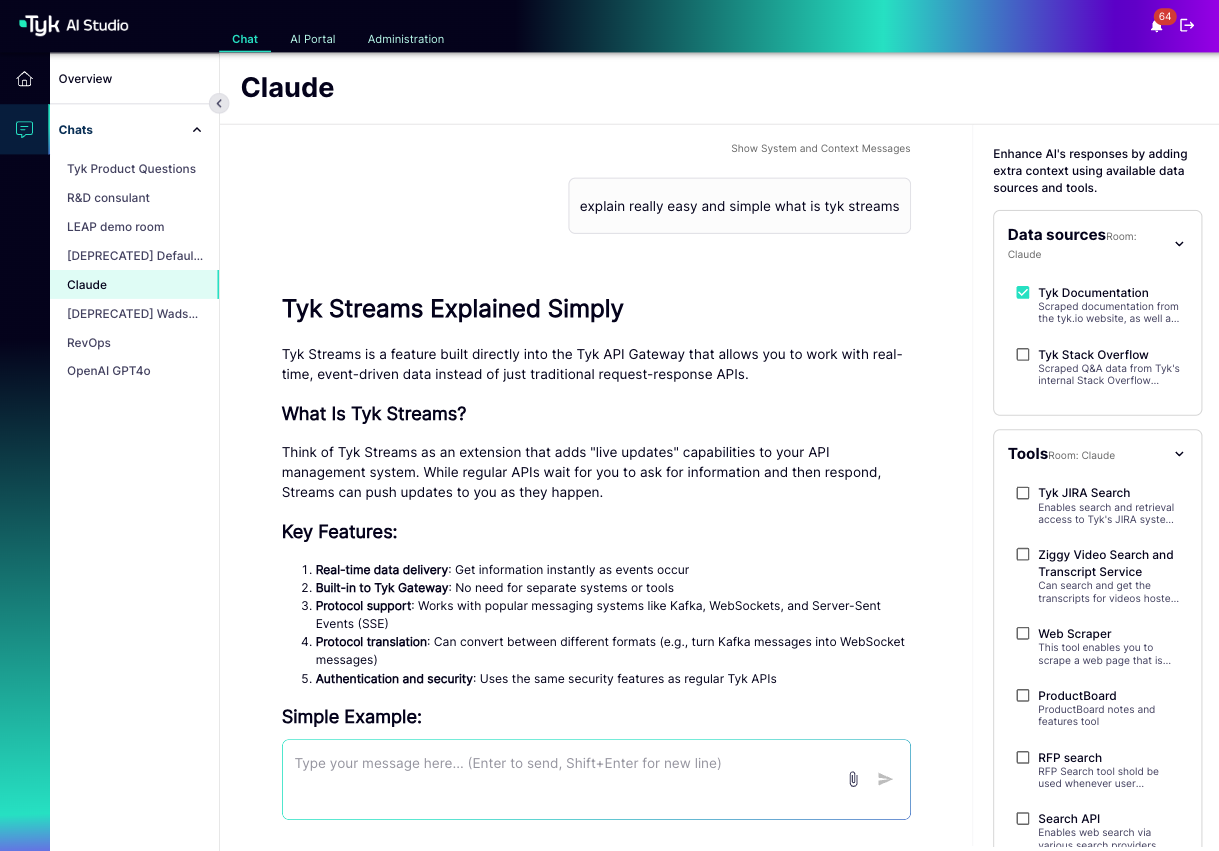
1. Navigate to the **Chat** tab at the top of the UI.
2. **Select Chat Experience:** Choose the `OpenAPI GPT4o` experience you just created from the list of available chats.
3. **Interact:** Type a question or prompt in the chat box.
4. **Receive Responses:** The LLM will process your request and stream the response back to you in the chat window.
## 4. Use the Chat Interface
1. Navigate to the **Chat** tab at the top of the UI.
2. **Select Chat Experience:** Choose the `OpenAPI GPT4o` experience you just created from the list of available chats.
3. **Interact:** Type a question or prompt in the chat box.
4. **Receive Responses:** The LLM will process your request and stream the response back to you in the chat window.
 You have now successfully configured an LLM and used it to answer a question through the Tyk AI Studio Chat Interface.
## Next Steps
With the initial configuration complete, you can now:
* Explore [User Management](/5.12/ai-management/ai-studio/user-management) to create users and groups.
* Set up [Tools](/5.12/ai-management/ai-studio/tools) for external API integration.
* Configure [Data Sources](/5.12/ai-management/ai-studio/datasources-rag) for RAG.
* Define [Filters](/5.12/ai-management/ai-studio/filters) for custom request/response logic.
You have now successfully configured an LLM and used it to answer a question through the Tyk AI Studio Chat Interface.
## Next Steps
With the initial configuration complete, you can now:
* Explore [User Management](/5.12/ai-management/ai-studio/user-management) to create users and groups.
* Set up [Tools](/5.12/ai-management/ai-studio/tools) for external API integration.
* Configure [Data Sources](/5.12/ai-management/ai-studio/datasources-rag) for RAG.
* Define [Filters](/5.12/ai-management/ai-studio/filters) for custom request/response logic.