> ## Documentation Index
> Fetch the complete documentation index at: https://tyk.io/docs/llms.txt
> Use this file to discover all available pages before exploring further.
# Catalogs in Tyk AI Studio
> How to manage catalogs in AI Studio?
## Availability
| Edition | Deployment Type |
| :---------------------------------------------------------------------- | :------------------- |
| [Enterprise](/5.12/ai-management/ai-studio/overview#enterprise-edition) | Self-Managed, Hybrid |
Catalogs in Tyk AI Studio are collections of AI resources ([LLM providers](/5.12/ai-management/ai-studio/llm-management), [Data sources](/5.12/ai-management/ai-studio/datasources-rag), and [Tools](/5.12/ai-management/ai-studio/tools)) that you can assign to specific [Teams](/5.12/ai-management/ai-studio/teams) to easily manage access. They act as the bridge between the raw AI capabilities and the users who need to consume them.
```mermaid theme={null}
graph TD
LLM[LLM Provider] -->|Added to| LLMCat[LLM Catalog]
Data[Data Source] -->|Added to| DataCat[Data Catalog]
Tool[Tool] -->|Added to| ToolCat[Tool Catalog]
LLMCat -->|Assigned to| Team[Team]
DataCat -->|Assigned to| Team
ToolCat -->|Assigned to| Team
Team -->|Grants access to| User[User]
```
### Use cases
* **Resource Grouping**: Group all OpenAI models into an "OpenAI Models" catalog and all Anthropic models into an "Anthropic Models" catalog to manage vendor access easily.
* **Environment Separation**: Create a "Production Data" catalog and a "Staging Data" catalog, ensuring that only the production Team has access to the production data sources.
* **Tool Bundling**: Bundle specific tools (like web search and calculators) into a "Research Tools" catalog for your data science Team.
### Community vs Enterprise Edition
In the **Community Edition**, catalog management is automated. There are three built-in **"Default" Catalogs** (one for LLMs, one for Data Sources, and one for Tools). Any new resource you create is automatically added to its respective default catalog, and these catalogs are permanently linked to the "Default" Team.
In the **Enterprise Edition**, you can create custom Catalogs, group specific resources together, and assign them to different Teams to enforce strict resource isolation and Role-Based Access Control (RBAC). The "Default" catalogs still exist and cannot be deleted.
## What is a Catalog?
A Catalog is a logical grouping of a specific type of AI resource. There are three types of catalogs in Tyk AI Studio:
1. **LLM Catalogs**: Collections of LLM providers (e.g., OpenAI, Anthropic, local models).
2. **Data Catalogs**: Collections of data sources (e.g., vector databases, knowledge bases).
3. **Tool Catalogs**: Collections of tools (e.g., web scrapers, calculators, custom APIs).
Catalogs do not grant access on their own. To make the resources within a catalog available to [Users](/5.12/ai-management/ai-studio/users), the catalog must be assigned to a [Team](/5.12/ai-management/ai-studio/teams).
## Configuration
When configuring a Catalog, the options vary slightly depending on the type:
### LLM Catalog
* **Catalog Name**: A descriptive name for the collection.
* **LLMs in this Catalog**: A list where you can add or remove specific LLM providers.
### Data Catalog
* **Catalog Name**: A descriptive name for the collection.
* **Short Description**: A brief summary of the data sources included.
* **Long Description**: Detailed information about the catalog's contents.
* **Icon**: A visual identifier for the catalog.
* **Data Sources**: A list where you can add or remove specific data sources.
* **Tags**: Labels to help categorize and filter the catalog.
### Tool Catalog
* **Name**: A descriptive name for the collection.
* **Short Description**: A brief summary of the tools included.
* **Long Description**: Detailed information about the catalog's capabilities.
* **Icon**: A visual identifier for the catalog.
* **Tools**: A list where you can add or remove specific tools.
* **Tags**: Labels to help categorize and filter the catalog.
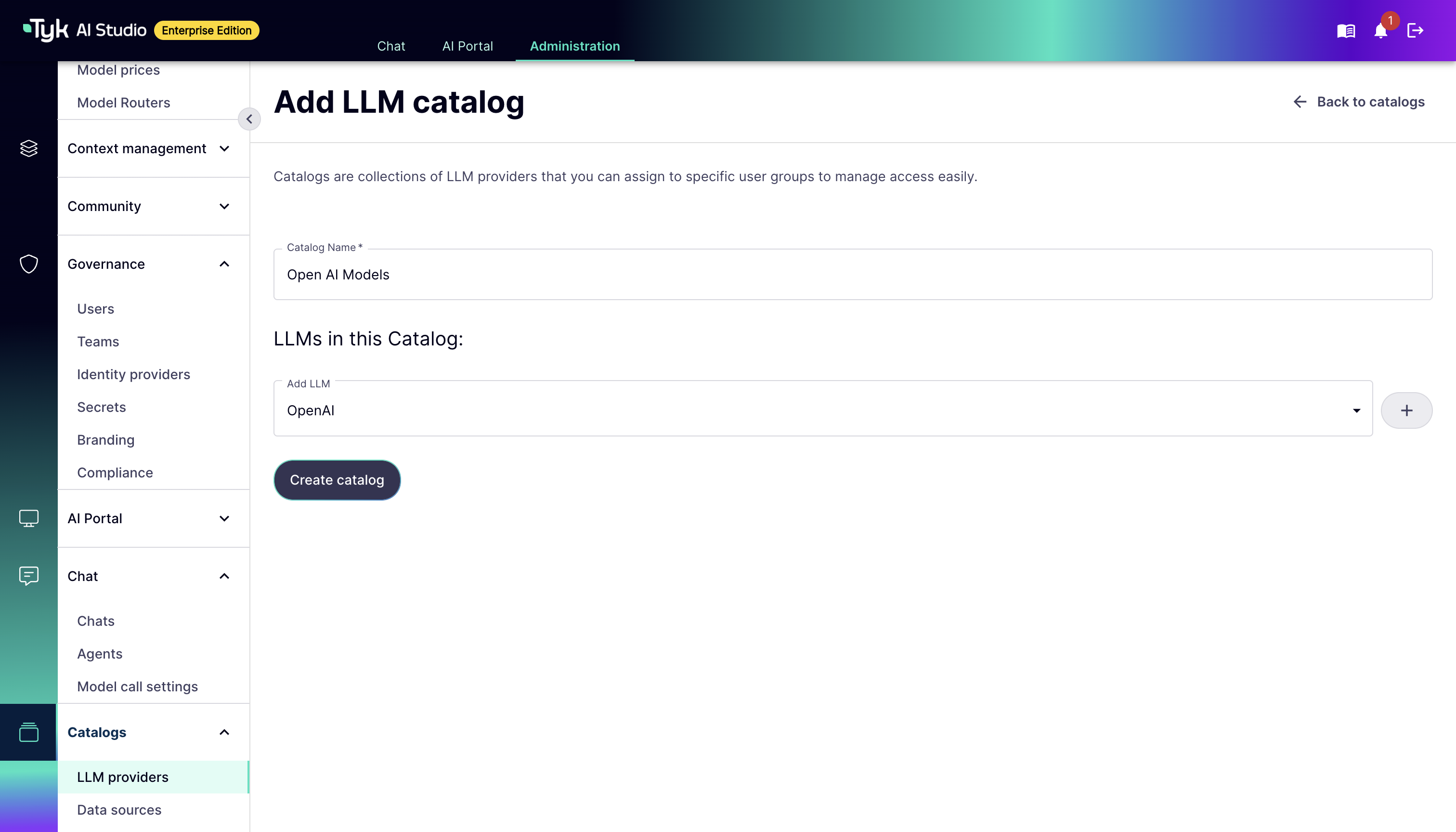
## How to Create an LLM Catalog
Catalogs are collections of LLM providers that you can assign to specific user groups to manage access easily.
To create a new LLM Catalog in Tyk AI Studio:
1. Navigate to the **Catalogs** section in the AI Studio dashboard.
2. Select the **LLM** tab.
3. Click on the **Add Catalog** button.
4. Fill in the **Catalog Name** (Required).
5. Under **LLMs in this Catalog**, click **Add LLM** to select the specific LLM providers you want to include.
6. Click **Save** to create the catalog.
7. Once created, navigate to the [Teams](/5.12/ai-management/ai-studio/teams) section to assign this catalog to a Team.
 ## How to Create a Data Source Catalog
Catalogs are collections of data sources that you can assign to specific user groups to manage access easily.
To create a new Data Catalog in Tyk AI Studio:
1. Navigate to the **Catalogs** section in the AI Studio dashboard.
2. Select the **Data** tab.
3. Click on the **Add Catalog** button.
4. Fill in the **Catalog Name** (Required) and **Short Description** (Required).
5. (Optional) Provide a **Long Description** and an **Icon**.
6. Under **Data Sources**, click **Add Data Source** to select the specific data sources you want to include.
7. Under **Tags**, click **Add Tag** to label and categorize the catalog.
8. Click **Save** to create the catalog.
9. Once created, navigate to the [Teams](/5.12/ai-management/ai-studio/teams) section to assign this catalog to a Team.
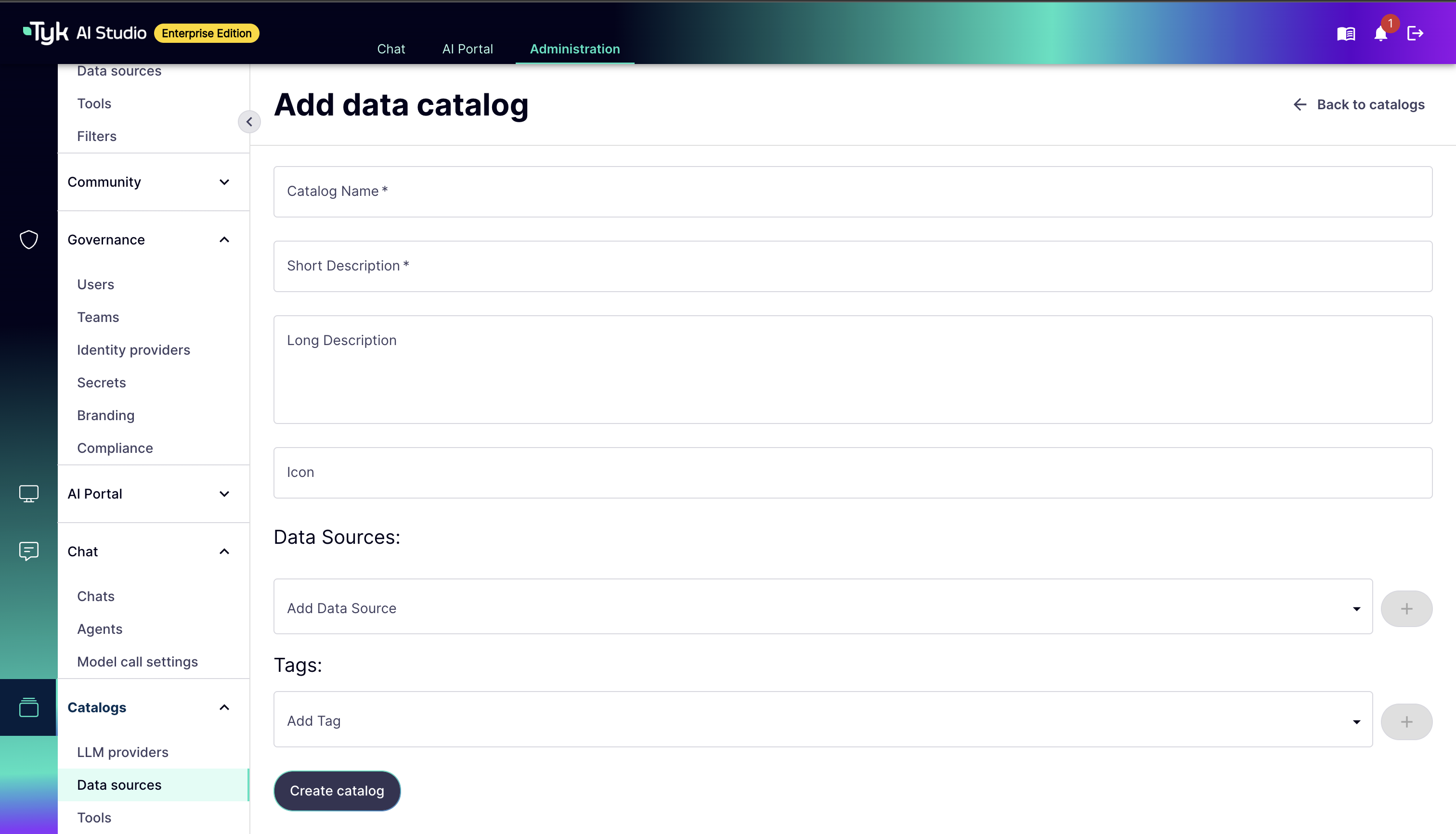
## How to Create a Data Source Catalog
Catalogs are collections of data sources that you can assign to specific user groups to manage access easily.
To create a new Data Catalog in Tyk AI Studio:
1. Navigate to the **Catalogs** section in the AI Studio dashboard.
2. Select the **Data** tab.
3. Click on the **Add Catalog** button.
4. Fill in the **Catalog Name** (Required) and **Short Description** (Required).
5. (Optional) Provide a **Long Description** and an **Icon**.
6. Under **Data Sources**, click **Add Data Source** to select the specific data sources you want to include.
7. Under **Tags**, click **Add Tag** to label and categorize the catalog.
8. Click **Save** to create the catalog.
9. Once created, navigate to the [Teams](/5.12/ai-management/ai-studio/teams) section to assign this catalog to a Team.
 ## How to Create a Tool Catalog
Catalogs are collections of tools that you can assign to specific user groups to manage access easily.
To create a new Tool Catalog in Tyk AI Studio:
1. Navigate to the **Catalogs** section in the AI Studio dashboard.
2. Select the **Tools** tab.
3. Click on the **Add Catalog** button.
4. Fill in the **Name** (Required).
5. (Optional) Provide a **Short Description**, **Long Description**, and an **Icon**.
6. Under **Tools**, click **Add Tool** to select the specific tools you want to include.
7. Under **Tags**, click **Add Tag** to label and categorize the catalog.
8. Click **Save** to create the catalog.
9. Once created, navigate to the [Teams](/5.12/ai-management/ai-studio/teams) section to assign this catalog to a Team.
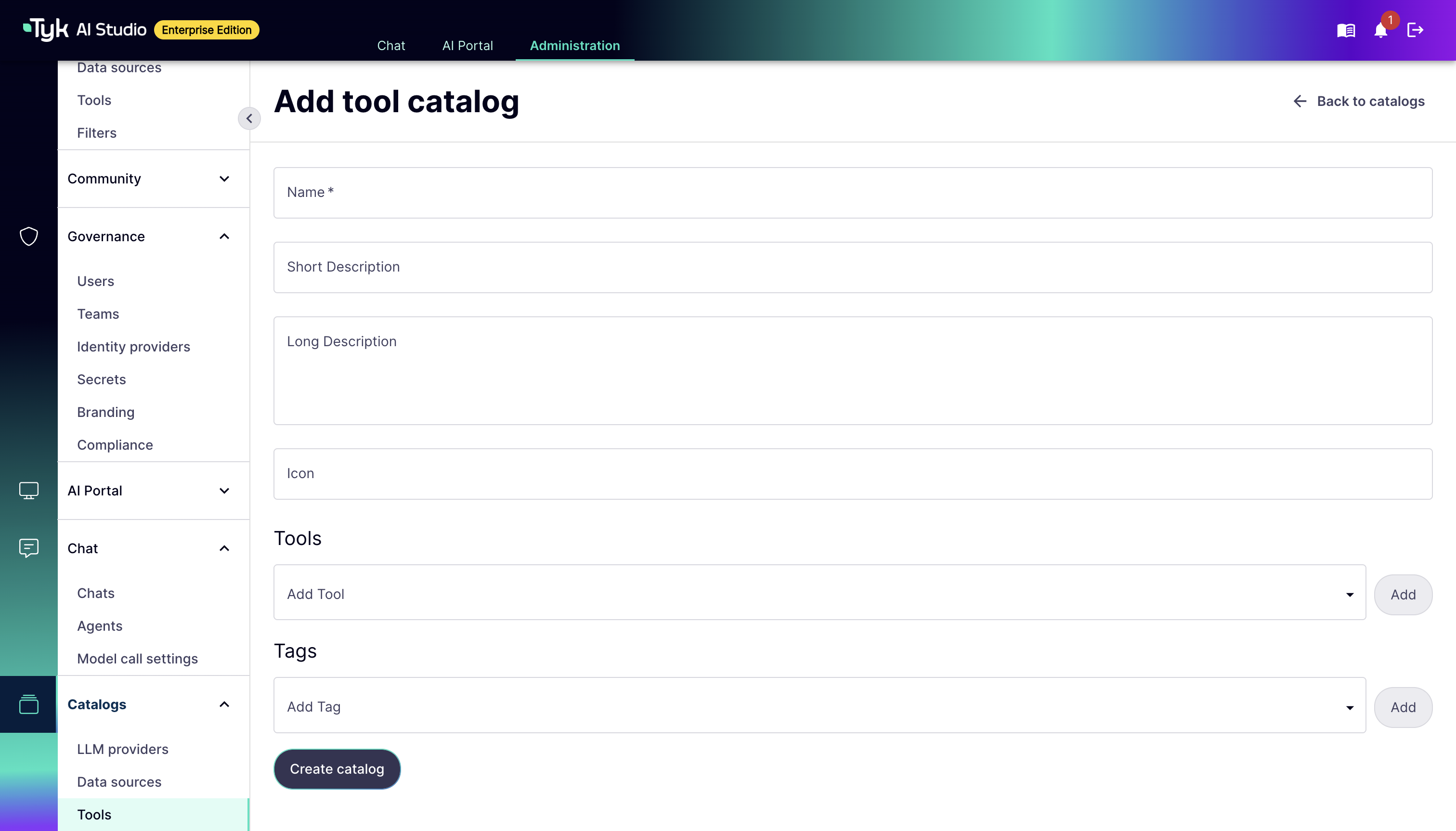
## How to Create a Tool Catalog
Catalogs are collections of tools that you can assign to specific user groups to manage access easily.
To create a new Tool Catalog in Tyk AI Studio:
1. Navigate to the **Catalogs** section in the AI Studio dashboard.
2. Select the **Tools** tab.
3. Click on the **Add Catalog** button.
4. Fill in the **Name** (Required).
5. (Optional) Provide a **Short Description**, **Long Description**, and an **Icon**.
6. Under **Tools**, click **Add Tool** to select the specific tools you want to include.
7. Under **Tags**, click **Add Tag** to label and categorize the catalog.
8. Click **Save** to create the catalog.
9. Once created, navigate to the [Teams](/5.12/ai-management/ai-studio/teams) section to assign this catalog to a Team.